


From August 26 to 29, 2026, the HICOOL 2026 Global Entrepreneur Summit themed “From Innovation Sources to Industrial Vanguard” was held at the China International Exhibition Center (Shunyi Pavilion) in Beijing. In the Healthcare Exhibition Zone of the Changping‑Future Science City Pavilion, Chunfeng Huayu (Beijing) Intelligent Medical Technology Co., Ltd. showcased its self‑developed world‑first three‑arm surgical robot. Boasting a groundbreaking human‑shaped three‑arm architecture and end‑to‑end intelligent surgical capabilities, the robot quickly drew widespread attention from the industry.
As an intelligent‑medical‑technology enterprise incubated and strategically invested in by Sanyou Medical (688085.SH), a listed company on the STAR Market of the Shanghai Stock Exchange, Chunfeng Huayu serves as a key pillar of Sanyou Medical’s core strategy of “Internationalization + Intelligence + Therapeutic Innovation”. Its overseas brand is 8i Robotics.
The company’s flagship product, the Spinal Surgery Navigation and Positioning System, was admitted to the NMPA Special Review Procedure for Innovative Medical Devices back in September 2025. It has now completed a Series‑A financing round worth hundreds of millions of yuan, with its commercialization roadmap firmly anchored to a closed‑loop ecosystem of “intelligent devices + innovative consumables”.
Drawing on the product‑portfolio strategy disclosed in Sanyou Medical’s 2026 semi‑annual report, Chunfeng Huayu’s intelligent surgical robot is generating synergies with the Shuimu Tianpeng ultrasonic energy system and a full lineup of therapeutically innovative implant systems. Meanwhile, leveraging the well‑established brand and distribution strengths of its French subsidiary Implanet, the group continues to introduce home‑grown innovative medical products into European and American markets.
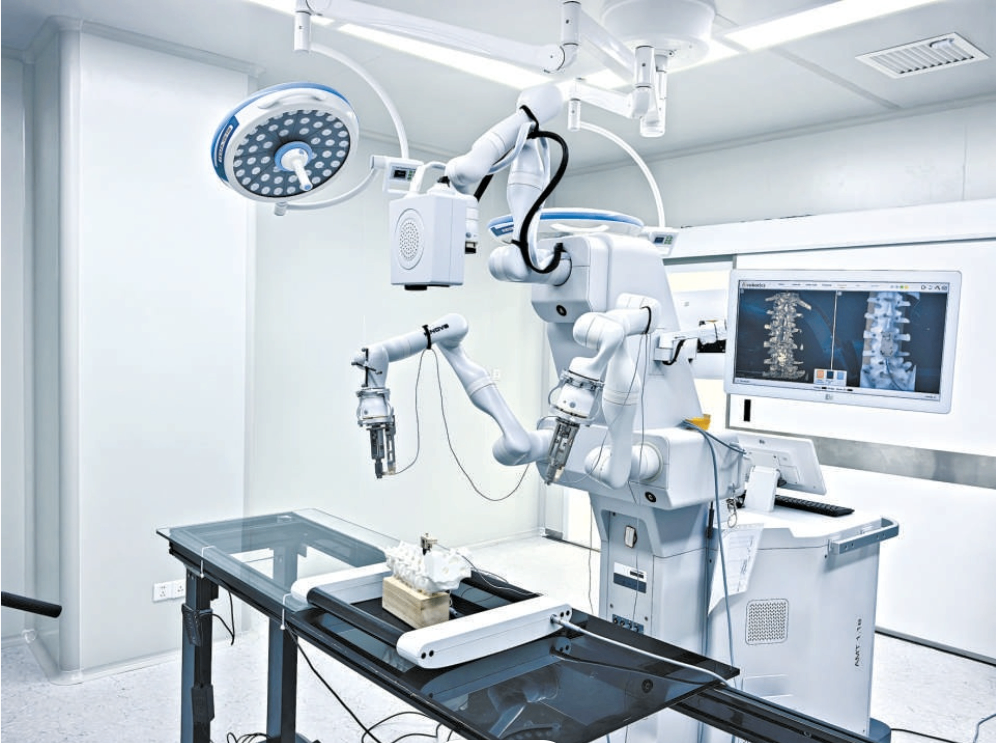
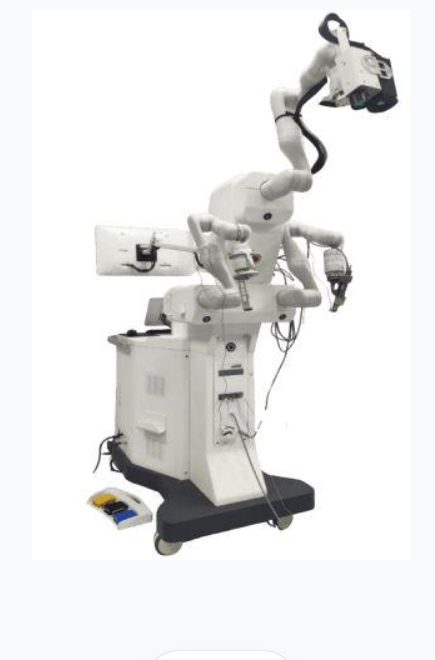
The core breakthrough of this world‑first three‑arm surgical robot unveiled at the event lies in completely breaking the performance limitations of conventional single‑arm surgical robots by adopting the globally exclusive innovative “human‑shaped three‑arm” architecture. The term “human‑shaped” does not mean its physical appearance imitates a human figure. Instead, it refers to the core robotic‑arm system’s high‑fidelity replication of the coordinated movement pattern of human upper limbs, which perfectly matches surgeons’ classic workflow of “bimanual manipulation plus binocular observation”.
Its three robotic arms perform distinct functions, forming a fully‑synchronized automated workflow covering “microscopic observation → bone cutting → screw placement”. Serving as the system’s “vision sensor”, the top visual arm is equipped with an OCT visual radar and high‑definition camera to deliver real‑time high‑precision optical navigation and intraoperative microscopic‑level imaging. Combined with electromagnetic navigation, it enables proprietary opto‑magnetic navigation technology that continuously tracks dynamic changes within the surgical site throughout the procedure.Acting as the “dexterous left hand”, the left arm carries the Shuimu Tianpeng ultrasonic energy system to perform automated drilling and precise bone‑tissue resection. Compared with conventional high‑speed burrs, it substantially lowers the risk of soft‑tissue injury and realizes full automation for bone‑preparation procedures.The independent right‑side powered arm, or “skillful hand”, incorporates a high‑precision force‑feedback system dedicated to high‑accuracy core operations such as pedicle‑screw insertion. It can closely replicate the wrist flexibility and fine tactile sensation of a human surgeon to autonomously carry out critical surgical steps.
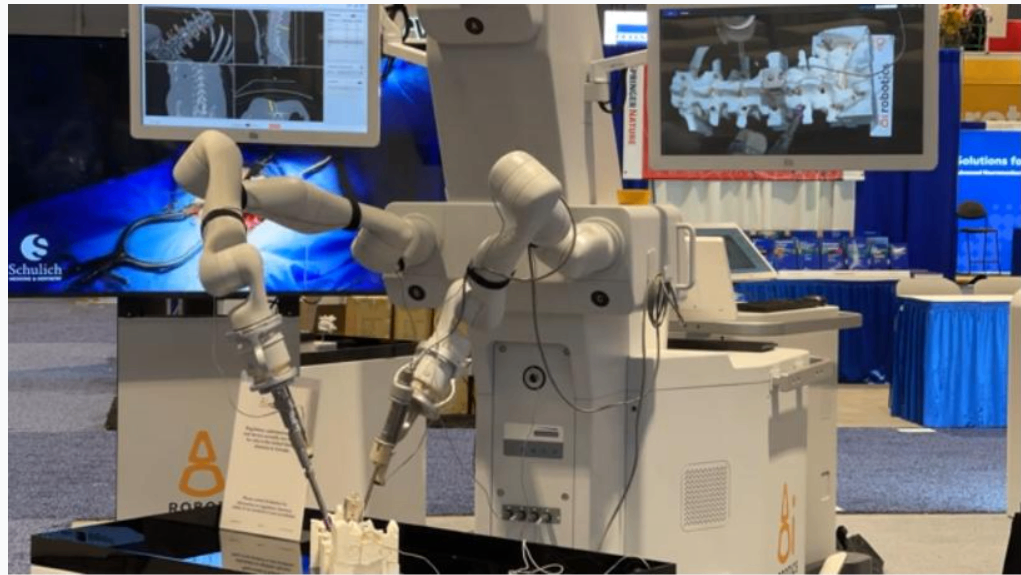
In terms of core‑technology breakthroughs, its integrated opto‑magnetic navigation system represents another key innovation with multi‑modal perception capabilities. On the optical‑navigation side, it incorporates an OCT visual radar, high‑definition camera and 3D LiDAR. The magnetic‑navigation module is equipped with a high‑precision electromagnetic navigation system, while an orthopedic digital microscope is also integrated. Its core specifications comprehensively outperform conventional solutions:Registration takes only 1‑2 seconds, in contrast to traditional workflows requiring dozens of minutes for reference‑frame mounting, intraoperative scanning and registration calibration. It delivers sub‑millimeter dynamic positioning accuracy of 0.9 mm, fundamentally resolving the pain point whereby the precision of conventional static navigation is compromised by respiratory motion. No intraoperative 3D‑ray scanning is required throughout the procedure, thus sparing both patients and medical staff from extra radiation exposure. During registration, the system captures the patient’s anatomical data in real‑time and automatically registers it against pre‑operative images, eliminating the need to attach an external reference frame.
This clinically‑valuable second‑level registration delivers far more than improved efficiency. More importantly, it does not alter surgeons’ established surgical workflows at all. After the patient is positioned, the surgeon proceeds with routine steps including disinfection, draping and incision exposure. Meanwhile, the visual arm automatically completes scanning and registration in the background. By the time the surgeon is ready, the robot is also fully set‑up, with zero additional waiting time throughout the whole process.
Furthermore, its built‑in dynamic‑sensing and respiratory‑compensation capabilities constitute a watershed core feature that distinguishes this robot from all existing orthopaedic surgical robots. During spinal‑surgery procedures, the patient’s respiratory movement can cause vertebral displacement ranging from 2 to 4 mm. Conventional navigation systems establish positional mapping based on static images captured at a single instant. They are unable to transmit intraoperative positional changes to the robotic‑arm control system in real‑time, resulting in noticeable operational latency. For spinal surgery where accuracy is measured in millimetres, such displacement can directly lead to inaccurate screw placement.
To address this common industry‑wide challenge, Chunfeng Huayu’s three‑arm robot delivers a complete three‑tier solution. First, the top visual arm integrates visual perception, 3D LiDAR and electromagnetic‑navigation technology to continuously track real‑time changes in the patient’s position with a dynamic positioning accuracy of 0.9 mm. Second, the system senses force‑feedback variations of intraoperative instruments in real‑time and automatically judges whether deviations have occurred in the patient’s condition or surgical operation. Finally, on the basis of continuous posture data and force‑feedback information, the robot dynamically adjusts the motion trajectory of its robotic arms in real‑time. Instead of rigidly executing the fixed pre‑operatively‑planned path, it constantly corrects its operational path in response to the patient’s respiration and evolving intraoperative conditions.
This technological breakthrough means that the robot has truly achieved a full closed‑loop of “execution + perception + adjustment”. Transcending the role of a conventional navigation tool, it has formally evolved into a human‑robot collaborative system capable of deep engagement in complex surgeries, delivering precise autonomous operations in critical procedures such as pedicle screw insertion.
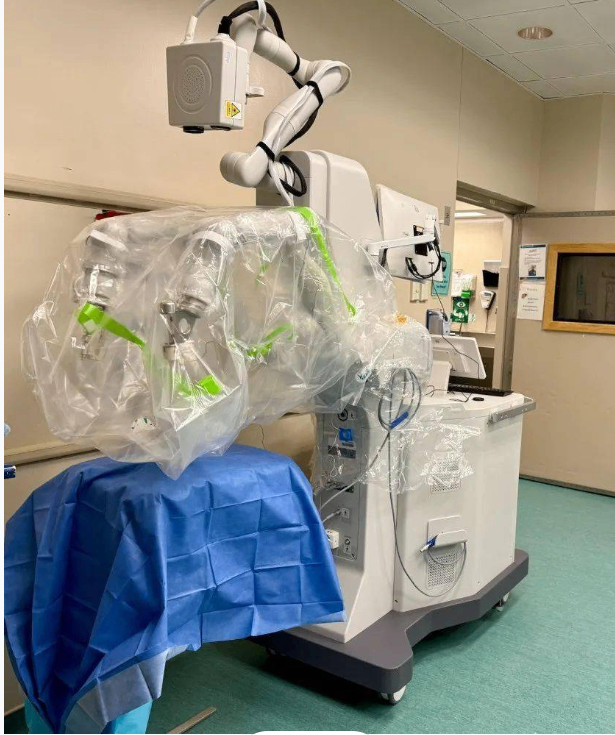
At present, the robot’s main application scope covers the full spectrum of spinal‑surgery scenarios. It supports Grade‑IV high‑difficulty operations including pedicle screw insertion, decompression, deformity correction and spinal‑tumor resection, making it the world’s only surgical‑robot product capable of covering all orthopedic‑spine procedures.
Clinically, conventional single‑arm orthopedic robots generally suffer from low operational efficiency. They can only cover one unilateral region of the surgical site at a time and, in most cases, merely perform a navigational positioning function to “show the way”, without the capacity for deep‑dive involvement in actual manipulation. By contrast, Chunfeng Huayu’s three‑arm design enables two manipulator arms to work simultaneously. Under the full‑time leadership and supervision of the surgeon, the arms collaboratively carry out the procedure, greatly improving operational consistency and overall surgical efficiency.
Compared with conventional single‑arm robots, Chunfeng Huayu’s three‑arm robot delivers comprehensive differentiated advantages. It has upgraded from a single‑arm configuration to a three‑arm combination consisting of one visual arm plus two powered arms. Its functional role has evolved from simple navigation guidance to hands‑on execution with deep‑level participation in bone cutting and screw placement. The registration workflow has been improved from the traditional intraoperative CT/3D‑ray scanning plus reference‑frame mounting to opto‑magnetic navigation with second‑level automatic registration, eliminating intraoperative radiation scanning. Its navigation capability has advanced from static navigation, which fails to track positional drift in real‑time, to dynamic sensing that monitors respiratory‑induced displacement at a precision of 0.9 mm. Surgical coverage has expanded from a single specific procedure to the world‑only full‑procedure coverage for spinal orthopaedics. Meanwhile, the powered arms are equipped with a high‑precision force‑feedback system.While the vast majority of orthopaedic robots remain at the “navigation‑tool” stage, Chunfeng Huayu has taken the lead in stepping into a brand‑new development phase as an intelligent operation platform. Its embodied‑intelligence concept brings the system much closer to true “robot‑performed surgery”, rather than conventional “robot‑assisted surgery”.
In addition, it introduces the concept of embodied intelligence into the field of orthopaedic robots for the first time. Leveraging its full closed‑loop capability of “execution + perception + adjustment”, it drives a paradigm shift for the whole industry from “navigation tool” to “intelligent operation platform”.
Chunfeng Huayu’s global deployment pace also takes an absolute leading position in the worldwide orthopaedic surgical‑robot track. It completed dual clinical verification across Europe and Asia in merely three months: domestic GCP‑compliant registration‑initiated clinical trials were launched in April 2026, followed by European research‑oriented installation in July of the same year. This timeline perfectly aligns with the explosive outbound‑expansion trend of Chinese‑made surgical robots. In H1 2026, China’s export value of surgical robots reached RMB 480 million, surging 3.3‑fold year‑on‑year. Its export footprint has expanded to 49 countries, and international recognition for domestically‑developed surgical robots continues to rise rapidly.
The global orthopaedic surgical‑robot market currently features a highly‑concentrated competitive landscape, with a CR5 ratio of approximately 89 %. Medtronic holds around 32 % of the global market share with its Mazor X product portfolio, adopting a full‑loop business model of “equipment + consumables + services”. Stryker captures roughly 28 % market share via its MAKO system, with a core focus on the joint‑replacement segment to achieve deep synergy between robotic hardware and implants. The remaining market share is divided among international giants including Johnson & Johnson Velys, Zimmer Biomet ROSA and Smith & Nephew CORI. Leading global players generally secure long‑term revenue from follow‑up implant consumables through robot installations, building a highly‑sticky commercial ecosystem with substantial barriers‑to‑entry.
Meanwhile, the trend of import substitution is well‑established in China’s market, with domestic products accounting for over 70 % of market share and a CR4 concentration ratio of approximately 80 %. Tinavi Medical leads the first‑tier players with a market share above 40 %. Its product portfolio covers the full spectrum of spinal, joint and trauma surgery scenarios, boasting over 200 cumulative robot installations and more than 150 000 completed procedures. J‑key Medical holds roughly 15 % market share and focuses primarily on the joint‑replacement segment. Yuanhua Intelligent and Rosenbot each capture around 10 % market share. Notably, Yuanhua Intelligent has achieved full in‑house development of its core components. Imported leader Stryker MAKO accounts for 8 %‑10 % of China’s market. A second‑tier group including Akcome, MicroPort, WEGO and Xinjunete, each with less than 5 % market share, is rapidly catching up within the joint‑surgery track.
As the core growth engine behind Sanyou Medical’s overall “Healthcare + AI” strategic layout, Chunfeng Huayu’s three‑arm surgical robot achieves deep‑seated synergy with its full lineup of therapeutically‑innovative implant systems, the Shuimu Tianpeng ultrasonic bone‑cutting system, and the AI‑powered surgical‑planning and intra‑operative decision‑making system. Meanwhile, drawing on Sanyou Medical’s 2026‑era investments in enterprises such as Zhuiyuan Medical and Hangzhou Yunxingui, the group further expands into innovative‑therapy tracks including cell and gene therapy. Leveraging the well‑established brand and distribution network of its French subsidiary Implanet, it continues to bring domestically‑developed innovative products into European and American markets.
Overall, the debut of Chunfeng Huayu’s three‑arm surgical robot at the HICOOL 2026 Summit marks that China’s originally‑developed orthopaedic surgical robots have officially transitioned from the “follower” stage into a new development phase of “parallel runner” and even “leader” in selected fields. Its core competitiveness can be summed up in three world‑first milestones: It is the world’s first orthopaedic surgical robot to adopt a “human‑shaped three‑arm” architecture, breaking the performance constraints of single‑arm devices and enabling synchronous automation of bone cutting and screw placement. It pioneers the deep integration of opto‑magnetic navigation and respiratory‑compensation technology to deliver sub‑millimetre dynamic positioning accuracy, fundamentally solving the long‑standing industry challenge of vertebral positional drift caused by respiratory motion. It achieves global‑first full‑procedure coverage across spinal orthopaedics, upgrading the product from a single‑procedure navigation tool to a multi‑procedure intelligent surgical platform.
From an industrial‑development perspective, the significance of this robot far transcends that of a standalone product. It stands as a typical microcosm of China’s medical‑device industry shifting from “import substitution” to “original‑technology export”. Amid the industrial boom — where the global orthopaedic surgical‑robot market is projected to reach RMB 56.7 billion by 2030 and China’s domestic market maintains rapid growth at an annual rate above 35 % — Chunfeng Huayu, with its uniquely‑developed technical pathway and fast‑track global clinical‑validation progress, offers a benchmark case worthy of sustained industry‑wide attention for high‑end global expansion of Chinese‑built surgical robots.