


China’s surgical‑robotics sector has reached another global milestone. According to a recent announcement on GeRay‑Tech’s official WeChat account, its Newton‑Endo series robot for minimally‑invasive spinal endoscopic surgery has successfully completed the world’s first in‑vivo animal experiment with autonomous robotic operation. The whole procedure was witnessed by the team led by Director Ding Yu from Chinese PLA General Hospital (Hospital 301).
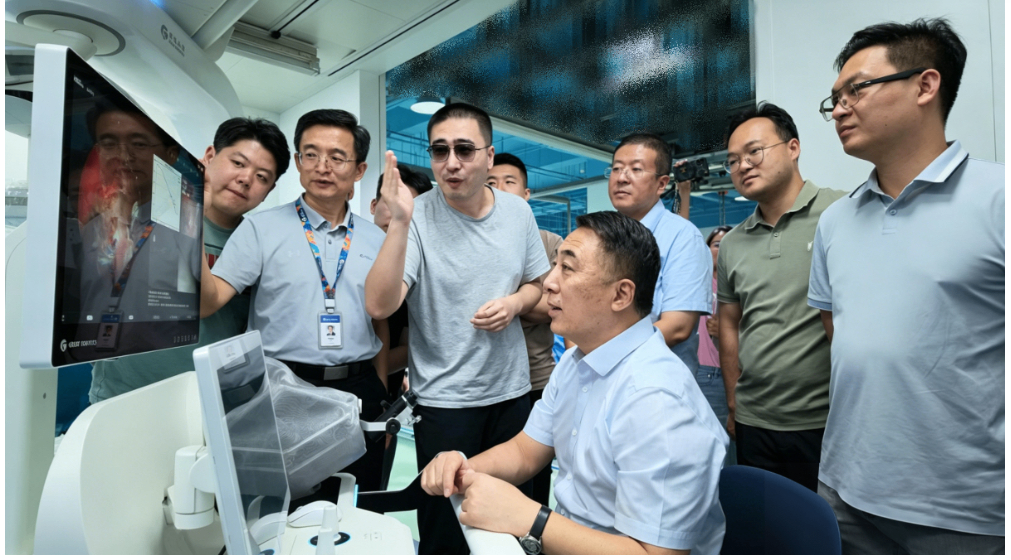
Director Ding Yu’s team and the R&D team of GeRay‑Tech observed the experiment and conducted in‑depth physician‑engineer exchanges.
Conducted under a rigorous framework of biosafety and ethical regulations, this experiment comprehensively verified the precision, stability and safety of the system in complex surgical scenarios. A 100 % surgical success rate was ultimately achieved, fully demonstrating that the Newton‑series robot is fully capable of end‑to‑end operations for minimally‑invasive spinal surgery across different vertebral segments and surgical approaches. This milestone marks the official transition of domestic‑developed spinal endoscopic robots from the “auxiliary positioning” phase into a brand‑new paradigm of “intelligent autonomous execution”.
The core performance achieved in this experiment has set new industry benchmarks for spinal endoscopic surgery across multiple dimensions. In terms of surgical efficiency, a conventional manually‑performed spinal endoscopic surgery takes surgeons an average of around 70 minutes, while junior surgeons may even spend 90‑100 minutes on the procedure. In this animal trial, despite the significantly narrower osseous corridors in animal spines compared with adult humans which raised the operational difficulty, experts completed the surgery using the Newton system in an average of only 50 minutes, delivering a substantial improvement in surgical efficiency.
In terms of surgical accuracy, the deviation between the skin puncture point planned by the system and the actual executed puncture site was merely sub‑millimeter‑level, with precision far exceeding the conventional standard of manual operations. For radiation control, the onboard Newton‑3D imaging system delivered an average radiation dose of only 0.3‑0.4 mSv, approximately 60 % lower than benchmark products of the same category and around 10 % of the dose from a conventional CT scan. This substantially reduces radiation exposure risks for both surgeons and patients during surgery. Post‑operative follow‑up results showed that all experimental animals regained normal mobility without any symptoms associated with nerve injury, which fully validates the clinical safety of the system.
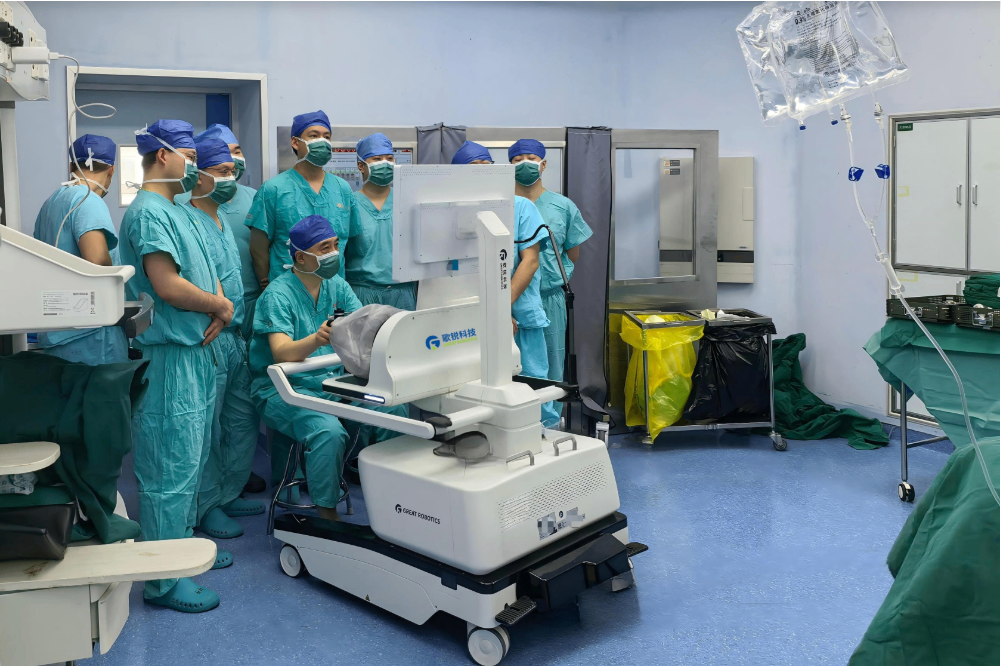
Breaking free from the technical limitation of most conventional spinal navigation‑positioning robots available on the market, which can only carry out positioning without performing surgical manipulation, the Newton‑Endo series has delivered original breakthroughs in multiple underlying technologies and achieved an industry‑wide paradigm upgrade. It is the world’s first master‑slave force‑controlled spinal endoscopic robot with composite precision actuation. Its proprietary master‑slave force‑feedback control architecture enables the robot to perform complex surgical motions under manual surgeon manipulation, while also delivering standardized autonomous execution empowered by large‑model AI. It also marks the first robotic system in the orthopedic field capable of participating in the full‑length surgical workflow via master‑slave force feedback.
This experiment was underpinned by Newton United, a large‑language model independently developed by GeRay‑Tech. Powered by this model, the robotic system can autonomously complete the full surgical workflow, including automatic lesion identification, instrument grasping, precise manipulation and safe withdrawal. Closed‑loop autonomous force‑control operation is realized throughout the whole procedure, forming an end‑to‑end intelligent operating system covering “imaging diagnosis‑surgical planning‑intelligent execution‑post‑operative assessment”.
Meanwhile, the team has innovatively developed an integrated large‑model architecture for depth estimation and segmentation based on a monocular transforaminal endoscope. Relying solely on two‑dimensional visual images captured by a conventional endoscope, the robot can reach the lesion site accurately in a single attempt, which greatly shortens the surgical workflow. Ultimately, the complete system establishes a full digital surgical closed‑loop of “perception‑decision‑making‑execution‑verification”. Combined with a dual‑arm collaborative actuation system and master‑slave force‑feedback control technology, the surgical manipulation precision is stably maintained at the sub‑millimeter level.
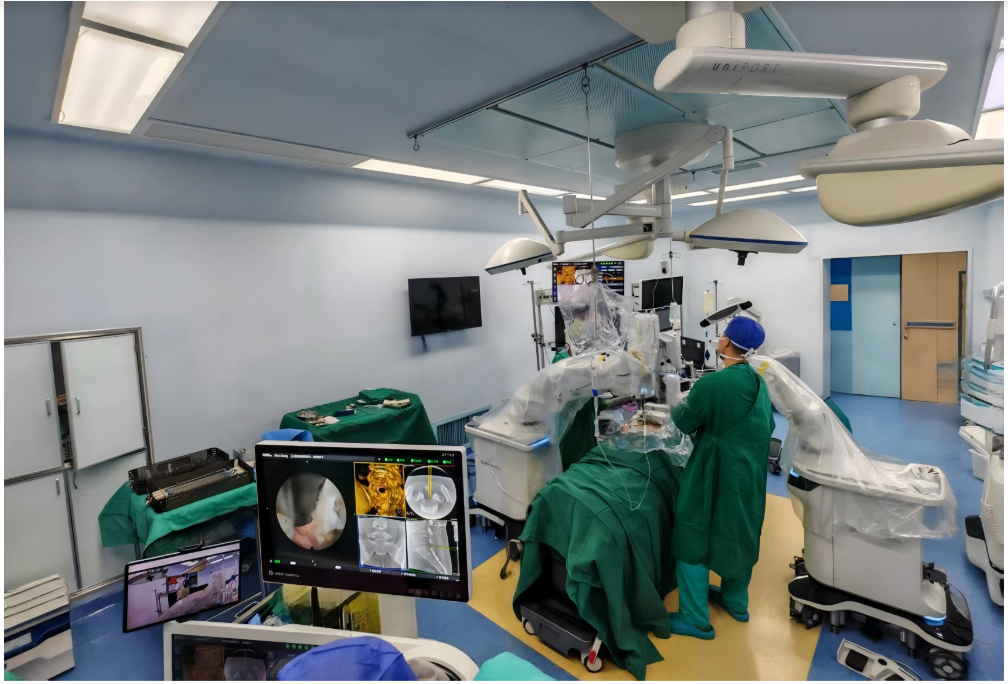
At present, clinical trials of the Newton‑Endo series robot on human subjects are progressing smoothly, and all trial procedures are about to be completed. Prior to this milestone, the product has finished hundreds of in‑vivo animal experiments and cadaver tests. It is now in the multi‑center human clinical‑trial phase, with in‑depth clinical‑research collaborations carried out alongside top‑tier domestic hospitals including Chinese PLA General Hospital and Qilu Hospital.
After witnessing the experiment on‑site, Professor Ding Yu stated that spinal endoscopic surgery is performed within an extremely narrow operative space with dense neurovascular distribution, imposing stringent requirements on surgical precision and dexterity. The development of autonomous operational capabilities based on the Newton‑Endo‑series robot and its large‑model technology essentially translates the surgical expertise of top specialists into reusable intelligent standards. In the future, the system is expected to help surgeons substantially improve surgical safety, markedly shorten the technical learning curve for young physicians, and fundamentally boost the homogenization of medical services at grassroots‑level healthcare institutions.
Several top‑tier orthopedic minimally‑invasive specialists who took part in the experiment offered consistent feedback: the Newton‑series system boasts user‑friendly operation with outstanding high precision and efficiency. Its master‑slave control function can effectively filter out involuntary hand tremors from surgeons, while the force‑feedback feature provides operators with haptic sensation close to that of real manual manipulation, making the system fully compatible with practical clinical requirements.
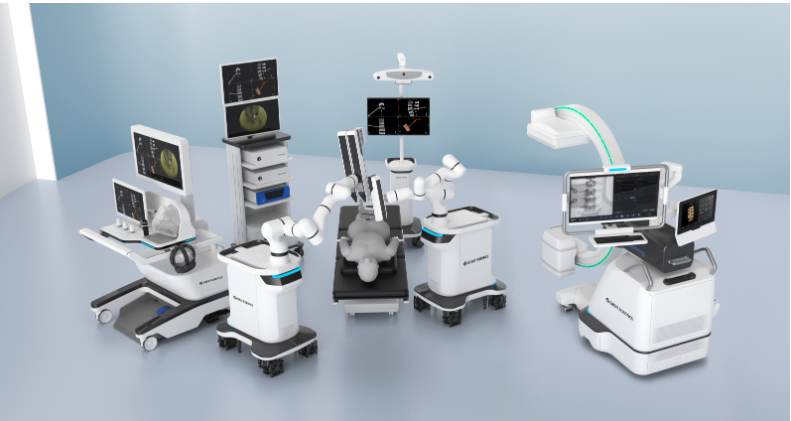
The success of this world‑first autonomously‑operated in‑vivo animal experiment carries strategic significance beyond the technical breakthrough of a single product. It marks that domestically‑developed innovative surgical robots have officially entered an era of high‑level autonomy, achieving the critical leap from “surgeon‑operated” to “intelligent autonomous execution”. Unlike the “follow‑up‑oriented import substitution” path previously taken by most domestic medical‑equipment manufacturers, the Newton series has fully mastered underlying core algorithms, software ecosystem and full‑chain system‑integration capabilities. Moving beyond the primary goal of import substitution, it has secured technological sovereignty over high‑end spinal endoscopic robots.
At present, GeRay‑Tech is accelerating the commercialization of its product through a rigorous clinical‑validation roadmap. With the conclusion of human clinical trials, the Newton‑Endo series minimally‑invasive spinal endoscopic surgical robot will soon be officially deployed for clinical use. It will not only drive the rapid development of minimally‑invasive spinal surgery toward intelligence, standardization and homogenization, but also lay a solid technical and clinical foundation for China’s high‑end intelligent medical equipment to take the global lead.