


On July 9, 2026, the Financial Times of the UK cited people familiar with the matter as reporting that Blackstone and TPG are looking to sell Hologic’s Surgical Unit for more than $4 billion (approximately 27.2‑billion Chinese yuan) and have engaged advisors to push forward with the deal.
This move comes merely three months after the two firms closed the privatization of Hologic. On October 21, 2025, Blackstone and TPG announced the acquisition of Hologic at an enterprise value of $18.3 billion (roughly RMB 124.3‑billion). The transaction was formally concluded on April 7, 2026, following which Hologic was delisted from the Nasdaq.
Buying the whole‑company stake for $18.3‑billion before spinning off its surgical business for $4‑billion clearly illustrates private‑equity firms’ classic buy‑and‑carve‑out strategy, while also laying bare underlying financial strains.
Deal Structure: Rapid Asset Monetization Following Leveraged Buyout
Blackstone and TPG adopted a classic leveraged buyout (LBO) structure for the acquisition of Hologic. Per transaction documents, the buyers secured USD 12.25‑billion debt financing commitments from a banking consortium consisting of Citigroup, Bank of America, Barclays, Royal Bank of Canada and Japan‑based Sumitomo Mitsui Banking Corporation. The package breaks down into a $9.5‑billion senior secured first‑lien term loan, a $2‑billion senior secured second‑lien term loan, alongside a $750‑million revolving credit facility.
Besides, a wholly‑owned subsidiary of the Abu Dhabi Investment Authority (ADIA) and an affiliate of Singapore’s Government of Singapore Investment Corporation (GIC) joined the deal as minority‑equity investors.
According to a January 2026 report by S&P Global Ratings, Hologic planned to raise roughly $11.5‑billion in debt to back the privatization. Its leverage ratio rose markedly post‑closing, resulting in a downgrade to a B+ rating.
In its July 9 report, Reuters pointed out that private‑equity firms are confronted with the predicament where strains in the private‑credit market spill over into adjacent private‑equity markets, prompting these firms to find ways to return capital to their investors.
The Financial Times also confirmed that Blackstone and TPG’s top‑priority goal for divesting the surgical division is to pay down acquisition‑related debts and distribute cash back to investors.
Divested Asset: Value Anchoring of Hologic’s Surgical Business
Hologic’s GYN Surgical division is one of its four core business segments, which concentrates on minimally‑invasive gynecological surgical devices with its product portfolio consisting of:
NovaSure: Endometrial Ablation System for the treatment of abnormal uterine bleeding
MyoSure: Hysteroscopic tissue‑removal system for polyps and fibroids resection
Fluent/Fluent Pro: Fluid‑management system designed for hysteroscopic procedures
Acessa ProVu: Laparoscopic radiofrequency ablation system (acquired from Acessa Health in 2020)
Sonata System: Transcervical ultrasound‑guided radiofrequency ablation system. Hologic purchased Gynesonics for approximately $350 million in October 2024 and closed the deal in January 2025.
Financially, this segment has posted steady‑growth performance in recent years:
Per Hologic’s Fiscal Year 2025 Form 10‑K filing ending September 27, 2025, GYN Surgical generated full‑year total revenue of $679.8 million, representing a 6.0‑percent year‑over‑year increase. Product revenue stood at $668.8 million, up 5.3% year‑on‑year. The acquisition of Gynesonics contributed $22.4 million in revenue.
The segment delivered an operating profit of $204.6 million with an operating‑profit margin of 30.1%, down from 35.0% in fiscal 2024 primarily because consolidation of Gynesonics added an incremental $26.6‑million operating expense.
Quarter‑level figures also reflect upward momentum. Surgical brought in $172.5‑million revenue in Fiscal 2025 Q4 (ending September 27, 2025), a 10.2% year‑over‑year rise. In Fiscal 2026 Q1 (ending December 27, 2025), its revenue reached $180.8 million, growing by 8.7 percent compared with the prior‑year period.
In terms of market standing, Hologic holds a leading position within the United States gynecologic device sector. According to a 2023 report from iData Research, Hologic, Medtronic, Cooper Surgical and Minerva Surgical jointly capture more than half of America’s gyne‑device market. Specifically, Hologic ranks top‑tier in endometrial ablation, hysteroscopic tissue removal, endoscopy and fluid‑management equipment markets.
Valuation Logic Behind the $4‑Billion Price Tag
Selling the steadily‑growing business generating roughly $680‑million annual revenue for over $4‑billion implies a price‑to‑sales (P/S) multiple of more than 5.9‑times. This valuation level should be interpreted in light of the following factors:
First, groum factor. wth‑premiGYN Surgical is one of the faster‑expanding divisions among Hologic’s four business segments. Its organic growth (excluding Gynesonics) hit 5.3% in Fiscal‑2025 Q4, comfortably outpacing the growth rates of Diagnostics and Breast Health businesses.
The global gynecological device market is projected to expand at an 8‑10% compound annual growth rate (CAGR), with surgical instruments accounting for the largest share at approximately 53‑54%.
Second, consumables‑fueled recurring‑revenue model. Devices such as MyoSure, NovaSure and Sonata require single‑use disposables, forming an equipment‑plus‑consumables business model favored by private‑equity investors for its steady cash flows.
Third, integration potential. Hologic’s surgical product portfolio covering endometrial ablation, fibroid ablation, tissue removal and fluid‑management systems addresses two major indications: abnormal uterine bleeding and uterine fibroids, delivering platform‑consolidation value for strategic buyers.
Fourth, sellers’ financial pressure. Blackstone and TPG are under pressure to deleverage quickly amid high‑interest‑rate conditions. According to a May 2026 report by Octus, the first‑lien term loan for this acquisition was priced at SOFR plus 275 basis points, with the second‑lien loan carrying even higher borrowing costs.
Against the backdrop of headwinds gripping the private‑credit market, monetizing non‑core assets expeditiously serves as the most straightforward approach to mitigate financial risks.
Profile of Prospective Buyers and Competitive Landscape
Prospective acquirers for Hologic’s surgical business may fall into the following categories:
Strategic buyers: Established gynecologic‑device participants such as Medtronic, J&J (Ethicon), Boston Scientific, Stryker and Cooper Surgical. In February 2026, Medtronic announced that its Hugo robotic‑assisted surgical system performed its first commercially‑deployed gynecologic surgery in the United States, demonstrating its intensified layout within gynecology segment.
J&J and Boston Scientific are also continuously expanding their surgical product portfolios.
Private‑equity buyers: Other PE firms may invest in this division to build out a gynecologic‑device platform and subsequently integrate niche‑sector assets via add‑on acquisitions. Per Bain & Company’s 2026 global healthcare private‑equity report, PE deal value within medtech nearly doubled to roughly $33 billion in 2025, driven mainly by carve‑out transactions and take‑private deals.
Comparison with Recent Comparable Transactions in the Same Sector
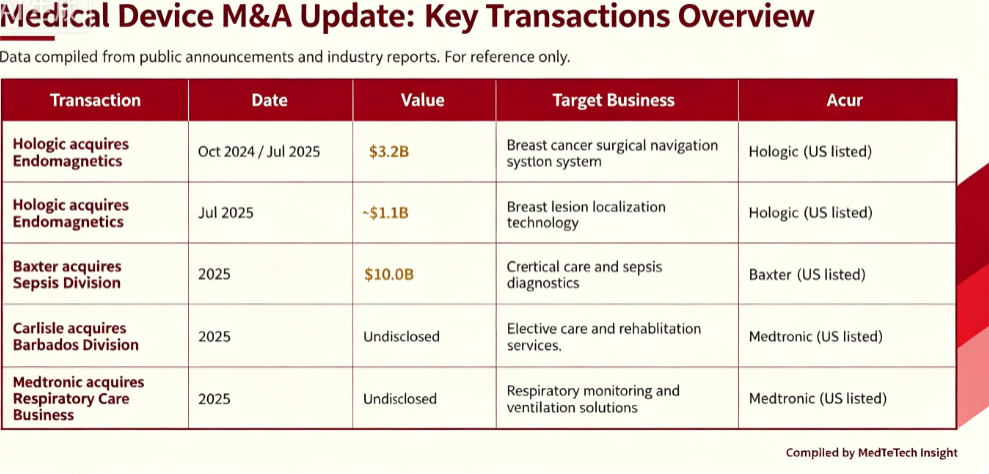
Note: No publicly‑disclosed specific timeline or buyer information is available regarding the sale of Hologic’s surgical division. The comparable transactions mentioned above serve only as industry‑sector references.
#Conclusion
Blackstone and TPG’s plan to divest Hologic’s surgical segment at a $4‑billion valuation essentially constitutes a stress test following their high‑leverage buyout. While this business boasts solid growth, a well‑established consumables‑driven revenue model and leading market standing, the PE owners’ financial structure compels them to monetize the asset within a short timeframe.
For prospective buyers, this presents an opportunity to acquire a mature gynecological‑device platform at a relatively reasonable valuation. For industry observers, this case lays bare private‑equity firms’ fast‑in‑fast‑out playbook in medtech, where capital efficiency takes precedence over long‑term operational improvement.
Key variables to verify moving forward include whether the final transaction price exceeds $4 billion, whether the acquirer will be a strategic player or another PE firm taking over the asset, and subsequent restructuring plans for Hologic’s remaining businesses (Diagnostics, Breast Health and Skeletal Health) post‑divestiture.