


On July 8, Johnson & Johnson officially announced that its Dual‑Energy THERMOCOOL SMARTTOUCH‑SF (DE‑ST‑SF) dual‑energy ablation platform has secured US FDA clearance for market launch. It marks the world’s first interventional device enabling seamless switching between radio‑frequency ablation (RF) and pulsed‑field ablation (PFA) within a single ablation catheter, reshaping clinical practices for atrial fibrillation ablation.

The newly‑approved DE‑ST‑SF ablation catheter is an upgraded iteration built upon the THERMOCOOL SMARTTOUCH‑SF pressure‑sensing radio‑frequency catheter with more than one‑million clinical cases worldwide. Drawing on the proven clinical track record of its well‑established predecessor, this new product supports two ablation energy modalities within one single catheter. Deeply integrated with Johnson & Johnson’s CARTO 3‑D mapping system, combined with contact‑force monitoring and real‑time assessment of ablation lesion indexes, the device allows physicians to switch ablation modalities intra‑operatively as needed and tailor personalized procedural strategies for distinct lesions. The two ablation modes deliver complementary advantages.
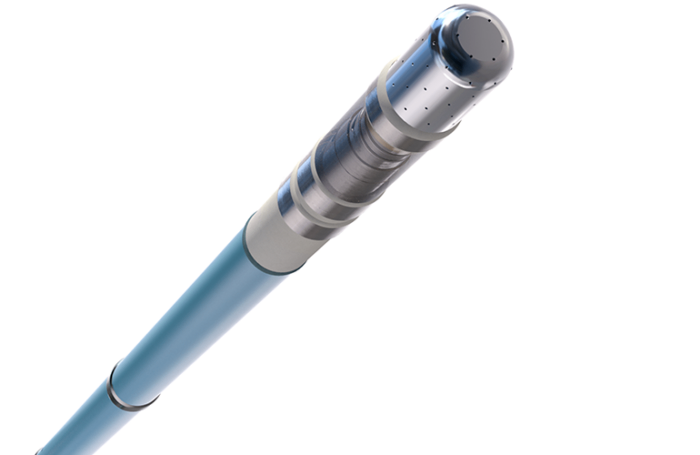
1.RF ablation
It relies on thermal energy to deliver precise ablation targeting delicate localized lesions and shows superior adaptability for complex substrates, atrial flutter, atrial tachycardia and other refractory pathologies.
2.Pulsed‑Field Ablation
It adopts a non‑thermal ablation principle and employs ultra‑short high‑voltage pulses to selectively damage cardiomyocytes while sparing surrounding tissues such as the esophagus and phrenic nerve, substantially lowering postoperative complications and shortening procedure duration. For complex cases including persistent atrial fibrillation, anatomically abnormal pulmonary veins and multiple co‑existing lesions, physicians can flexibly switch ablation modalities without exchanging procedural consumables mid‑operation. This approach retains RF ablation’s strengths in addressing complex lesions while harnessing the enhanced safety benefits of pulsed‑field ablation.
Michael Bodner, Group Chairman of Johnson & Johnson’s Electrophysiology and Neurovascular division, stated that FDA clearance for the DE‑ST‑SF platform marks a pivotal milestone in Johnson & Johnson’s electrophysiology‑focused innovation journey and empowers clinicians to manage increasingly complex arrhythmia cases. As scheduled, the product will roll out commercially in phases across the United States this summer with initial clinical procedures performed. This dual‑energy ablation catheter obtained CE certification and launched in Europe as early as late 2024. After validation via overseas clinical practice, it is now officially introduced to the US market. Down the line, Johnson & Johnson plans to initiate NMPA registration in China at an appropriate time.
Beyond breakthroughs within the electrophysiology segment, Johnson & Johnson announced on June 25 the initiation of the global pivotal IDE trial for its Shockwave SkyRunner Carotid IVL System to advance US‑based clinical trials. The study plans to enroll up to 320 subjects (160 via carotid‑artery approach and 160 through femoral access) across a maximum of 50 sites in the United States. Each cohort will include an extra 25 in‑hospital patients alongside a five‑year long‑term follow‑up period.
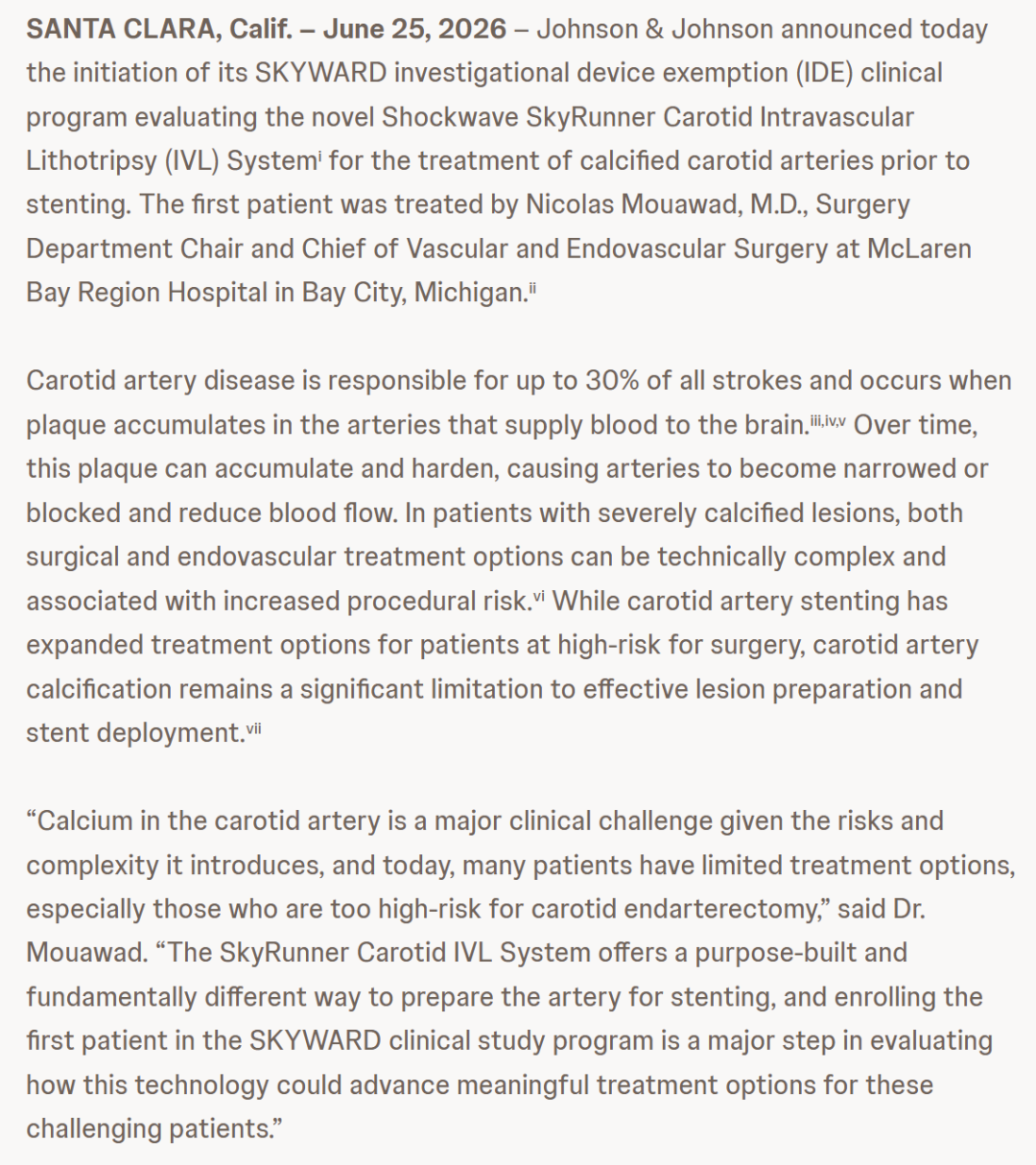
This expansion of IVL into the carotid‑artery field employs shockwaves to break down calcified plaques and lower risks of vessel dissection and cerebral embolism, addressing a long‑standing drawback of conventional high‑pressure balloon dilation, which tends to dislodge plaques and trigger strokes. This milestone means that after coronary and peripheral vessels, intravascular lithotripsy (IVL) technology has officially entered the neuro‑intervention space, enabling Johnson & Johnson to establish its footprint across the full vascular landscape.