


News from Smart Medical Device Network: Jiejing Medical recently announced that its single-use electronic upper/lower gastrointestinal imaging catheter has successfully passed the review by Liaoning Provincial Medical Products Administration and officially obtained the Class II Medical Device Registration Certificate.
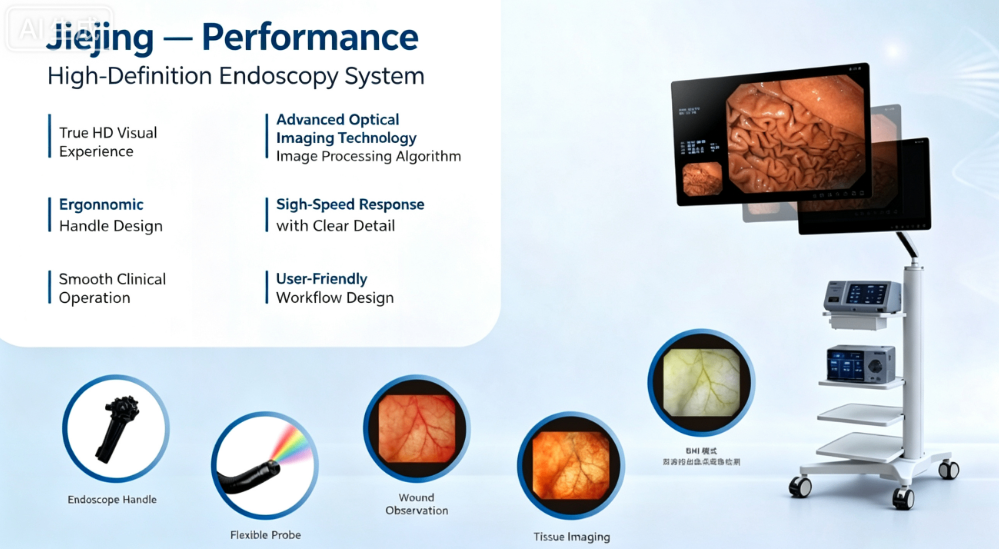
Jiejing Medical stated: “As a tangible achievement of innovative medical device commercialization, this approval marks the full industrialization of our split semi-disposable single-use endoscope technology. The company has achieved a commercial breakthrough in its core product pipeline, and now possesses full capabilities covering national channel recruitment, clinical promotion and large-scale mass production.”
According to available data, there are currently 8 registered single-use electronic upper gastrointestinal endoscope products and 7 single-use electronic lower gastrointestinal endoscope products in China, leaving ample room for market growth.
Yet Jiejing Medical stands out thanks to its differentiated technical route. Its original semi-disposable electronic endoscope adopts a split design featuring reusable key components and single-use tissue-contacting parts, which disrupts the conventional models of fully reusable endoscopes and fully disposable endoscopes, pioneering a new technical direction for the industry.
It is reported that traditional gastrointestinal endoscopy requires a rigorous 45-minute reprocessing and disinfection procedure after each examination. Each reusable endoscope can only serve 7 patients per working day, placing medical institutions under dual pressures of limited diagnostic efficiency and heavy disinfection workload.
The adoption of split semi-disposable gastrointestinal endoscopes not only eliminates the risk of cross-infection, but also greatly boosts clinical efficiency by delivering ready-to-use performance with no waiting period for cleaning and disinfection. This transforms the workflow from "patients waiting for available scopes" to "scopes ready for patients", drastically cutting down patients’ waiting time.
Meanwhile, in terms of cost reduction, only the disposable distal component needs to be replaced. Its per-procedure cost is more than 50% lower than that of fully disposable endoscopes, and its long-term running cost is less than that of conventional reusable endoscopes, balancing hospital economic benefits and patients’ financial burden.
At present, Jiejing Medical has built a product layout covering upper and lower gastrointestinal tracts, with extended applications across multiple clinical departments. Moving forward, the company will rapidly develop a full-spectrum product portfolio of medical endoscopes.
From the perspective of the single-use endoscope market, as a new type of medical device intended to replace conventional reusable endoscopes, single-use medical endoscopes feature core strengths including zero risk of cross-infection, no need for reprocessing and disinfection, simple operation and low maintenance costs. They thoroughly resolve long-standing industry pain points of traditional reusable endoscopes such as incomplete disinfection, high consumable wear, low turnover efficiency and prominent hidden risks of cross-contamination. These devices are widely deployed in minimally invasive diagnosis and treatment across multiple clinical departments, including gastroenterology, pulmonology, urology, otolaryngology and orthopedics.
Overall, the global single-use medical endoscope industry is on a rapid growth track. Driven by mature healthcare systems, sound hospital infection control regulations and strong demand for high-end minimally invasive diagnosis and treatment in Europe and the United States, the market size keeps expanding steadily.
Multiple industry datasets indicate that the global single-use endoscope market reached a scale of USD 3.1 billion (equivalent to over RMB 22 billion) in 2025. It is projected to expand to USD 3.53 billion in 2026 and is expected to surpass USD 10.3 billion by 2034, with a compound annual growth rate (CAGR) of 14.3% from 2026 to 2034, demonstrating highly certain long-term growth prospects.
From a regional market perspective, North America ranked first globally with a 38.38% market share in 2025, hitting a market size of USD 1.19 billion. Its key growth drivers include stringent hospital infection control regulations in the United States, a mature medical insurance reimbursement system, high penetration of premium minimally invasive diagnosis and treatment, and rigorous infection risk management implemented by medical institutions.
The European market ranks second. Its market size is projected to reach USD 1.04 billion in 2026. Supported by sound medical infrastructure and high healthcare spending in countries including Germany, the United Kingdom and France, it maintains a steady growth rate of 13.3%.
The Asia-Pacific region is the world’s fastest-growing market segment, with its market size projected to hit USD 660 million in 2026. Emerging markets including China, India and Southeast Asia boast a large population base, continuously improving medical infrastructure and rapidly rising penetration of minimally invasive diagnosis and treatment, making them the core growth engine driving the global market expansion.
China’s single-use medical endoscope industry took shape later than its counterparts in Europe and the United States. In the early stage, the domestic market was largely monopolized by overseas industry giants. Over the past five years, however, fueled by supportive policies, technological breakthroughs and advantages of local domestic supply chains, the industry has achieved leapfrog development with a growth rate far exceeding the global average, emerging as a core growth market worldwide.
Industry data indicates that China’s single-use endoscope sector is transitioning from an explosive introductory phase to a rational high-speed expansion phase. The domestic market size achieved a substantial surge in 2025, and it is projected to grow steadily in 2026 with a year-on-year growth rate staying above 11%. The industry has bid farewell to disorderly expansion and entered a stage of high-quality growth.
In terms of penetration rate, the penetration of all domestic segmented product categories remains at a low level at present, leaving massive room for improvement:
The penetration rate of single-use endoscopes stands at approximately 20% in pulmonology, 10% in urology, merely 2%–4% in otolaryngology, and less than 1% in gastroenterology, all far below the figures seen in mature European and American markets.
Furthermore, the penetration rate of single-use endoscopes in domestic pulmonology, urology and otolaryngology departments is expected to rise to 70% in the future. For gastroenterology, the penetration rates of single-use gastroscopes and colonoscopes are projected to reach 13% and 4% respectively. The continuous growth in penetration will drive industrial expansion over the long term.
However, it should be noted that while domestic manufacturers have mature technologies and achieved mass production in the mid-to-low-end single-use endoscope segment, they still face technical shortcomings in high-end niche tracks. Cutting-edge technologies such as high-resolution imaging, ultra-thin flexible catheters, multi-channel synchronous operation, AI-assisted diagnosis and treatment, and ultra-long battery life remain monopolized by leading overseas enterprises. Domestic high-end products still lag behind international brands in performance, stability and clinical adaptability.
Meanwhile, numerous small and medium-sized manufacturers crowd into the mid-to-low-end market segment, resulting in severe homogenization in product functions, technologies and appearances. Most enterprises lack independent core R&D capabilities and compete for market share merely by slashing prices. This leads to fierce low-end internal competition and shrinking profit margins, which hinders the high-quality upgrading and development of the whole industry.
Nevertheless, it is undeniable that in the long run, as core devices for minimally invasive medicine, precision medicine and hospital infection prevention and control, single-use medical endoscopes align with the core development trends including global upgrades in medical safety, popularization of primary healthcare and iteration of minimally invasive technologies. The industry boasts solid growth logic and highly predictable long-term expansion.
Driven by continuous technological breakthroughs, falling costs and expanding application scenarios, single-use endoscopes are expected to gradually replace traditional reusable endoscopes and become the mainstream equipment for endoscopic diagnosis and treatment. This segment is poised to evolve into a hundred-billion-yuan market track in the future, ranking among the most investment-worthy and promising subsectors in the medical device industry.