


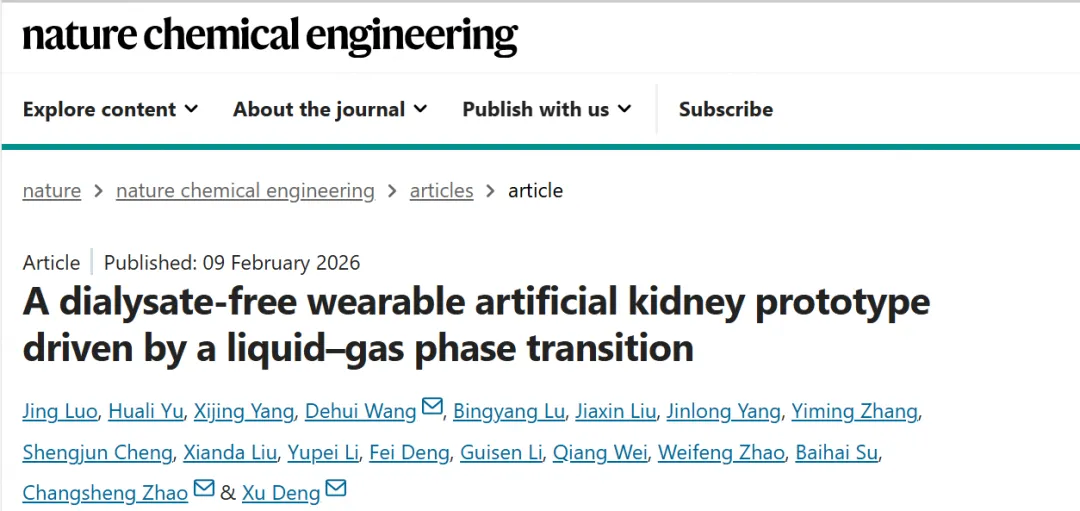
For millions of people with end-stage kidney disease, life is often programmed around dialysis. A study published in Nature Chemical Engineering now describes a new possibility: a dialysate-free wearable artificial kidney prototype based on a liquid-gas phase transition.
Part 1. Device design
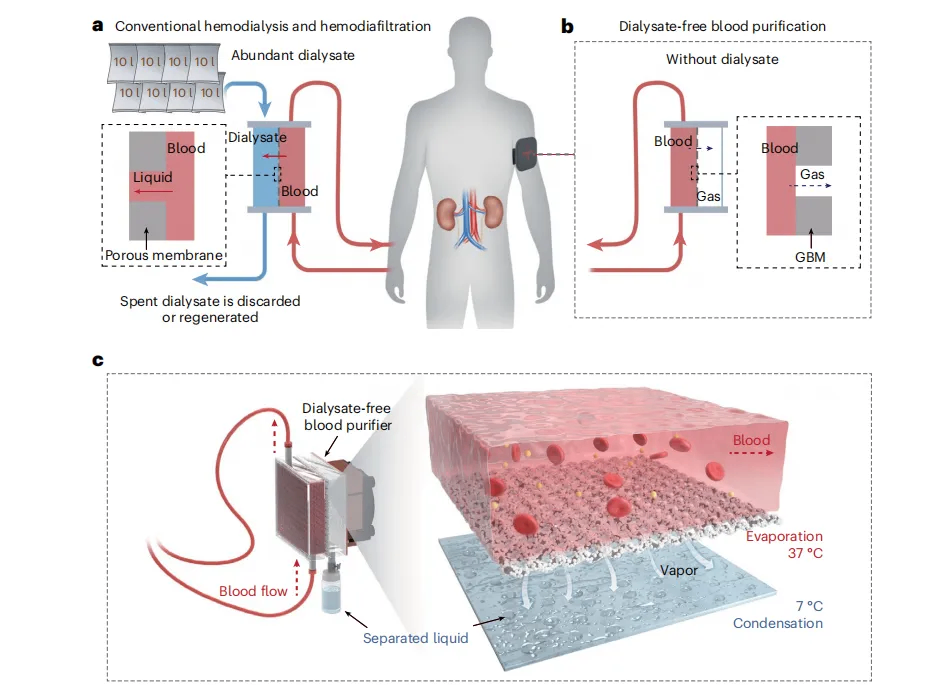
Conventional dialysis is difficult to miniaturize because it relies on liquid-liquid exchange and requires 120 to 150 liters of dialysate per session. The new device replaces flushing with evaporation. At its core is a dialysate-free blood purifier built around gas-permeable, blood-repellent membranes, or GBMs. Water is separated through a gas-pressure-driven liquid-gas phase transition, while uremic toxins are removed through adsorption.
The membrane has a super-hemophobic surface created by nano-silica particles, so blood stays above the membrane rather than wetting it. Water in blood evaporates at body temperature, crosses the membrane as vapor, and is then condensed and collected on the other side. The team systematically optimized pore size, blood-flow rate, and temperature difference to improve dehydration performance.
Safety testing showed no significant activation of coagulation or inflammation. Even after prolonged flushing and soaking, the membranes retained stable super-hemophobic performance.
Part 2. Animal experiments
In the first experiment, 20 healthy rabbits underwent six hours of extracorporeal circulation using the purifier. Clear fluid was removed successfully, and some small-molecule toxins such as urea, uric acid, and creatinine were also detected in the separated fluid. Oxygen saturation remained above 95%, there was no sign of gas embolism, blood cells remained stable, hemolysis stayed below 5%, electrolytes were preserved, inflammatory cytokines did not rise, and pathology showed no major organ injury.
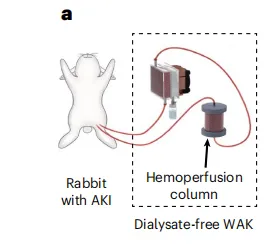
In the second experiment, the researchers connected the purifier to a hemoperfusion cartridge containing adsorption resin to create a full artificial-kidney prototype for rabbits with acute kidney injury. The combined system reduced creatinine more effectively than either component alone and also lowered beta-2 microglobulin, while preserving albumin and total protein.
Summary and discussion
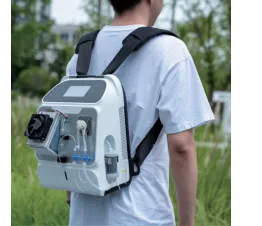
Based on these data, the investigators integrated all modules into a wearable artificial-kidney prototype weighing less than 3.8 kilograms. The device includes a dehydration system, a toxin-removal system, a battery, a micropump, and multiple sensors.
Further optimization is still needed, including broader toxin clearance, lower weight, and greater intelligence. Even so, the study shows that dialysate-free blood purification is no longer science fiction.