


Researchers at The University of Texas at Austin are pioneering a 3D printing method that could pave the way for new developments in prosthetics, flexible medical devices, and stretchable electronics.
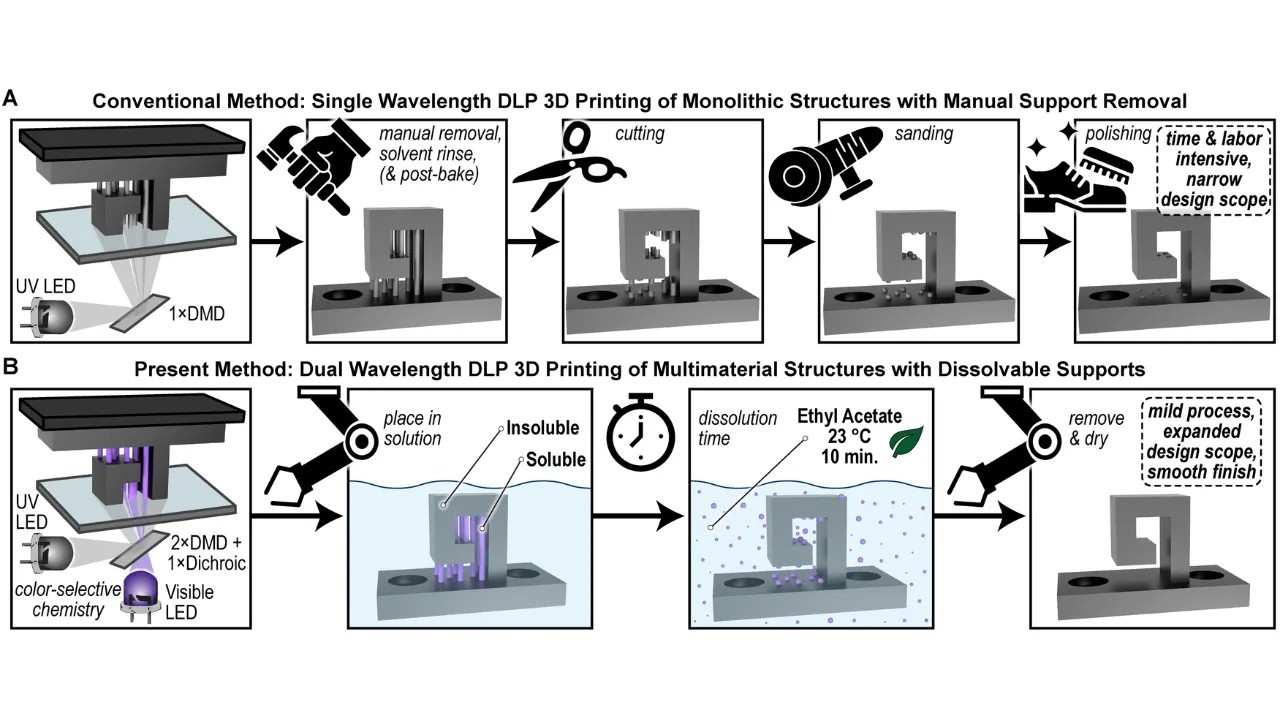
The new printing method, inspired by a blending of toughness and flexibility like rigid bones and pliable cartilage, merges soft and hard properties together by using custom-designed liquid resin and a dual-light printing system.
When hit with violet light, the resin becomes stretchy and rubber-like, but when hit with higher-energy ultraviolet light, it becomes strong and rigid.
“Multimaterial printing has been a longstanding desire to be able to do, and there are commercial 3D printers available that can create very intricate multimaterial structures. This pervasive challenge of interfacial failure, particularly between two materials, the more different they get, continues to be a major challenge in the multimaterial 3D printing space. That is because the overlap and interconnectivity between the materials becomes weaker generally as you make those materials more and more distinct from one another,” Zachariah Page, assistant professor at UT Austin and a leading researcher on the new 3D printed material.
“The way our resin overcomes that challenge is by having one of those components be present throughout the entire structure and building in a second component only in specific regions. If the soft material is present throughout and the hard material is built into that soft material, that allows us to have these interconnected interfaces between the two structures. Those kinds of strong covalent bonds between them end up resulting in a cohesive instead of an adhesive interaction.”
The new process will create medical devices that can move more naturally with the body in a flexible manner, like a joint or ligament, instead of a rigid manner.
“We already have a lot of ubiquitous devices that are inherently rigid. Electronic devices, prosthetics, where you need that structural integrity to be able to have the functionality desired,” Page said. “However, at the same time, we want to be able to interface with the human body which is oftentimes soft and compliant in its mechanical properties. This mismatch between hard and soft can lead to discomfort, acute reactions, that can be a significant problem in the medical space.”
Product developers then have the availability to create one printed object with areas of both softness and hardness. Having an in-house printer gives researchers, hospitals, and educators access to this nextgen material in a quick, simple, and affordable manner.
“The barrier to entry [for 3D printing] is relatively low,” Sona Dadhania, principal technology analyst at IDTechEx and a contributor to the "3D Printing and Additive Manufacturing 2024-2034: Technology and Market Outlook” report, explained.
The new printed material can be used to prototype surgical models, wearable sensors, soft robots and more. Researchers have created an early prototype stretchable electronic device with a bendable strip and a rigid section to prevent circuit breakage. They also printed a smaller demo version of a knee joint with flexible ligaments and rigid bones.
“We are still at early phases of customer discovery and figuring out what the best use cases are going to be for these structures that interface hard and soft components, but early discussions have led us towards surgical devices, or rather surgical models for doctors and training doctors to be able to perform and practice on patient specific components that would give them the ability to learn about what the field will be like as they come into the material and coordinate the entire team that is performing the surgery about how the process will go before going into operation,” Page said. “That is one area with a lot of potential.”
“Additionally, we have been thinking about prosthetics. The idea there is to create patient specific structures, scanning a person's body to find and create a perfect fit for a prosthetic device. Our 3D printing capability can then seamlessly interface with a soft human body with that idealized fit to a more hard, rigid prosthetic device that provides functionality for individuals using it. We also think it could extend far beyond that, into wearable health sensors. Anywhere you are interacting between hard components and soft human tissue.”
3D printing has taken off in popularity across the medical field over the last decade, with surgical guides and pre-operative models being commonly printed for medtech applications.
Around 62% of dental labs in the US that have adopted 3D printing use the technology for dental aligners, splints/nightguards, temporary and permanent crowns and bridges, and impression trays. In addition, an estimated 99% of hearing aids today are produced through 3D printing.
In addition, Page and his team of researchers are continuously working on other developments in 3D medical printing that could soon make waves in the device space.
“One of the exciting emerging areas in bioprinting that we would like to contribute to is with respect to creating tissue specific models so you can test and characterize different diseases in a 3D environment that better mimics in vivo conditions,” Page said. “The kind of traditional way that people are currency going and trying to study disease is to look at cellular materials in vitro on a hard 2D service, which is different from the human body. Being able to create more biogenetic 3D structures where we can look at cellular materials and interactions with the environment would be a transformative capability.”
While all of the 3D printing that has occurred with the new resin technique has been on a small scale, Page is optimistic about scalability moving forward.
“We are beginning to explore transmissibility. All of our lab scale testing has been done on small samples, just because of the access to the printers that we have, however what is great is that the components we use are themselves inexpensive building blocks that are commercially available,” Page said. “In terms of being able to produce larger scale structures, it's just a matter of having the device for that. The devices for larger scaling 3D printing of this type do exist, and we are in the process of acquiring one that will let us create larger structures or many small structures at once.”