


A lawsuit against Medtronic’s hernia mesh products recently went to trial in federal court in Boston. This case is the first among thousands of U.S. lawsuits targeting Medtronic hernia meshes to be heard by a jury.
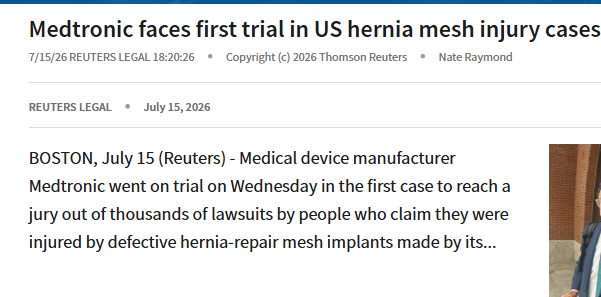
It is reported that the focus of this lawsuit centers on hernia repair meshes manufactured by Covidien, a subsidiary of Medtronic, which allegedly caused various post-surgical complications and irreversible injuries to patients.

In mass tort litigation, such cases are known as "bellwether trials". Courts select bellwether cases for priority adjudication to serve as a reference for subsequent mass settlement negotiations or coordinated group trials. Given the enormous scale of the litigation involving Medtronic, the verdict in this case carries substantial referential value for the industry and judicial practice.
The case is presided over by U.S. Federal District Judge Patti Saris. The plaintiff is Larry Patterson, a resident of Alabama, and the defendant is Medtronic. At present, approximately 10,350 plaintiffs across the United States have filed claims against Medtronic over multiple lines of hernia mesh products, including the Parietex, ProGrip and Symbotex series. These plaintiffs allege that Medtronic’s hernia meshes inflicted bodily harm after implantation and caused irreversible physical injuries.
Most of the claims are currently consolidated in Massachusetts. Approximately 7,450 plaintiffs’ lawsuits are pending in state courts, while another 2,400 cases have been consolidated into federal multidistrict litigation.
Notably, most other manufacturers facing similar hernia mesh claims have resolved disputes through settlements. As such, the industry is closely watching Medtronic’s trial, which serves as a critical benchmark for stakeholders to gauge jury award standards and define companies’ responsibilities with respect to risk warnings.

In this case, plaintiff Larry Patterson alleges that he underwent hernia repair surgery in 2017, during which a Symbotex mesh was implanted. The mesh triggered intestinal obstruction several years after the operation, forcing him to undergo a second surgery in 2020. Counsel for the plaintiff contends that the incident stems from significant deficiencies in Medtronic’s product design and risk disclosures.
The plaintiff’s evidence shows that the collagen coating on the surface of the Symbotex mesh serves as the core protective structure of the product. It was originally designed to separate the polyester mesh substrate from the patient’s intestines during abdominal cavity healing, preventing direct contact that could lead to adhesions, obstruction and other complications.
However, Medtronic’s earlier products utilized bovine collagen coatings, while the subject mesh switched to porcine collagen material. Meanwhile, Medtronic’s sales representatives told clinicians externally that the coating could maintain its protective effect for approximately 30 days. Internally, however, the company was aware that porcine collagen would be absorbed by the human body in roughly seven days — a timeframe insufficient to support abdominal healing, ultimately resulting in complications.
In response, Medtronic denied during the trial that the product suffered from design defects or inadequate warnings, contending that the plaintiff’s physical injuries were not caused by mesh failure. Medtronic argued that the patient developed complications three years after surgery — a lengthy interval with multiple potential contributing causes. The plaintiff suffers from underlying conditions including obesity and diabetes, and factors related to surgical technique significantly elevated his risk of hernia recurrence. The company maintains that his injuries stem from these factors rather than any defect in the product.
According to publicly available information, the trial is expected to last three to four weeks. Both the plaintiff and the defendant will submit extensive evidence focusing on three core dimensions: causation, risk warnings, and product design. The jury’s deliberations thereafter will shape the verdict of the case.

As one of the common surgical procedures, hernia repair meshes can be categorized by material into synthetic, biological and composite meshes.
Among them, synthetic meshes are further divided into absorbable and non-absorbable types. Absorbable meshes can be subcategorized into fully absorbable and partially absorbable varieties. Absorbable meshes are made of materials such as polylactide and blended fibers. They have low tendency to trigger infection and tissue adhesion, and most are absorbed by the human body within three months. Non-absorbable meshes are generally fabricated from polyester, polypropylene, expanded polytetrafluoroethylene (ePTFE) and other materials. Polypropylene is currently the most commonly used mesh material for hernia repair.
Most currently available biological meshes are derived from mammalian tissues including porcine, bovine and ovine sources. Dermal tissue is the most prevalent raw material, while pericardium and small intestinal submucosa (SIS) are also used in certain products. Biological meshes feature absorbability and favorable long-term comfort, yet they carry risks of autologous degradation and hernia recurrence.
Composite meshes (anti-adhesion meshes) consist of a base substrate and an anti-adhesion barrier, which can be joined by adhesion, suturing or intercalation. Polyester and polypropylene are widely adopted as base substrate materials. Anti-adhesion barriers fall into absorbable and non-absorbable categories. Absorbable barrier materials include collagen, oxidized regenerated cellulose and sodium hyaluronate, whereas non-absorbable variants encompass expanded polytetrafluoroethylene (ePTFE) and polyvinylidene fluoride (PVDF).
In terms of market competition, major international players engaged in hernia mesh products include Medtronic, Johnson & Johnson, BD Medical, B. Braun and other global giants. Domestic manufacturers consist of Xinhua Medical, Tianzhu Changyun, Wego, Tianyi Biology, Zhuoruan Medical and others.
It should be emphasized that compared with imported products, domestic meshes currently boast notable advantages in cost performance, localized clinical adaptability and after-sales response, and the scope for import substitution continues to expand.
——
For now, although this Medtronic case involves only an individual claim, its final verdict will serve as the first judicial benchmark for defining risk liability associated with Medtronic’s hernia mesh products.
Should Medtronic be found liable in this bellwether trial, such a ruling may, beyond the U.S. market, further accelerate the shift in procurement by domestic hospitals toward compliant domestic alternatives.