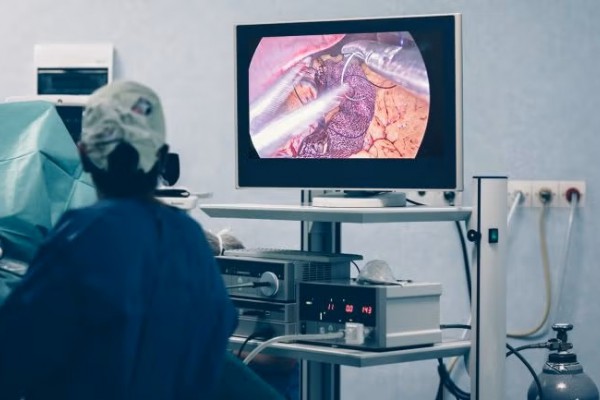



A newly established smart hospital successfully accommodated a 370 percent surge in monthly general anesthesia surgical volume while markedly improving turnover efficiency by deploying an integrated Operating Room Information System paired with intelligent automation. In a retrospective study published in the Journal of Medical and Biological Engineering, authors Wen-Tsung Tsai, Chiung-Fang Hsueh, Shie-Tsung Chen, and Chia-Lun Lee reported that the facility’s surgical turnover time compliance rate increased from a pre-implementation baseline of 65.8 percent to 80.4 percent during the post-implementation evaluation phase. This operational enhancement was driven by the coordinated introduction of autonomous mobile robots for physical transport, paperless clinical documentation, and laser-engraved QR-code tracking for surgical instruments, demonstrating how digital architecture and physical robotics can together reinforce perioperative throughput in high-demand clinical engineering environments.
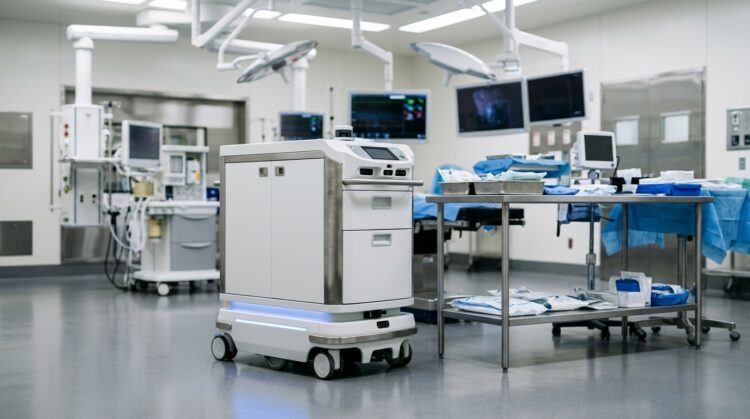
Smart Hospital Operating Room System and Mobile Robots Boost Surgical Efficiency
The investigation examined the operational impacts, architectural integration, and comprehensive system design of this technological deployment across all general anesthesia surgeries performed between August 2024 and December 2025. To rigorously evaluate the clinical engineering outcomes, the researchers partitioned the seventeen-month timeline into two distinct observational periods. The pre-implementation baseline period extended from August 2024 through February 2025, capturing baseline procedural metrics prior to the system launch. The subsequent post-implementation evaluation period spanned March 2025 through December 2025, providing ten months of continuous operational data under the fully activated automation ecosystem. By comparing these two consecutive timeframes, the study tracked how the hospital maintained procedural standards and adapted to escalating procedural loads following the transition.
At the core of the hospital’s technological infrastructure was an integrated Operating Room Information System organized into two principal operational domains: the Intelligent Perioperative Care Workflow and the Intelligent Supply Chain and Logistics Workflow. Delineating this structured data model was central to supporting seamless perioperative interoperability across different medical and administrative departments. To evaluate system performance, the investigators relied on direct data extraction from institutional digital records rather than manual self-reports. General operational efficiency indicators and patient safety metrics were harvested directly from Hospital Information System logs, while the operational logs generated by autonomous mobile robots provided precise, automated records of instrument transport cycle times across the surgical suite.
The automation of routine logistics yielded substantial operational dividends, most notably by recovering extensive working hours previously lost to manual transit tasks. Across the evaluation timeframe, automating supply chain and logistical workflows accumulated 49,892 minutes of fragmented time savings. The authors emphasized that capturing these fragmented minutes was equivalent to releasing potential clinical nursing capacity back into the surgical department. Alongside these substantial time savings, procedural quality and risk management indicators showed marked gains. Surgical checklist compliance reached a flawless 100 percent compliance rate during the evaluation period, while the surgical facility maintained a record of zero instrument loss, validating the reliability of digital tracking mechanisms.
In addition to efficiency and safety improvements, the transition to digital workflows produced measurable environmental sustainability outcomes. Replacing traditional administrative records with digital documentation eliminated 72,090 physical sheets of paper from perioperative operations. Using standardized carbon conversion formulas established by the Ministry of Economic Affairs, the researchers quantified the ecological impact of this paper reduction, determining that it translated directly into a 360.5-kilogram reduction in carbon dioxide emissions. Meanwhile, staff perceptions of the digital ecosystem were evaluated using a validated Likert-scale questionnaire. The resulting survey data demonstrated a strong positive consensus among hospital personnel, with favorable agreement rates exceeding 90 percent across every evaluated system module.
In their conclusion, the authors determined that coupling an integrated Operating Room Information System with an intelligent automation ecosystem significantly enhances operational efficiency, patient safety, and ecological sustainability within a newly established surgical environment. By resolving logistical bottlenecks and unifying digital records under a single structured perioperative data model, the clinical engineering framework successfully accommodated rapid surgical volume growth without compromising turnover compliance or instrument control. The researchers emphasized that this robust, interoperable data model does not merely resolve immediate workflow bottlenecks, but also establishes a scalable technological foundation capable of supporting a future learning health system.
Subject of Research: Clinical engineering outcomes of an integrated operating room information system with autonomous mobile robots.
Article Title: Design and Implementation of an Integrated Operating Room Information System (ORIS) with Autonomous Mobile Robots: Clinical Engineering Outcomes in a Smart Hospital
Article References: Tsai, W.-T., Hsueh, C.-F., Chen, S.-T., & Lee, C.-L. (2026). Design and Implementation of an Integrated Operating Room Information System (ORIS) with Autonomous Mobile Robots: Clinical Engineering Outcomes in a Smart Hospital. Journal of Medical and Biological Engineering. https://doi.org/10.1007/s40846-026-01064-4
Image Credits: AI Generated
DOI: 10.1007/s40846-026-01064-4