DARPA is concurrently advancing two cutting‑edge technology pathways related to the brain.
One targets faster, larger‑scale non‑invasive brain‑computer interfaces. DARPA’s newly announced Firefox program seeks to further break through limitations in speed, scale and data‑processing capacity by building upon existing non‑invasive optical BCI technologies.
The other targets the brain’s inherent plasticity. Dubbed the SHINE program, it seeks to leverage tools including synthetic biology, molecular engineering and neuromodulation to act with greater precision on specific brain regions and neural circuits, enabling the repair and remodeling of dysfunctional neural networks.
From "reading the brain" to "modulating the brain", the two programs in effect point to DARPA’s longer‑term strategy in neurotechnology.
01
Firefox: Scaling Up Non‑Invasive Brain‑Computer Interfaces
DARPA will host a Proposers’ Day for the Firefox program on September 1, with registration closing on August 21.
Over the past several decades, DARPA has consistently invested in brain‑computer interfaces and related neurotechnology research. Ranging from controlling unmanned systems via neural signals, restoring motor function for wounded service members, to treating neurological disorders and sustaining warfighters’ cognitive performance under extreme environments, establishing more efficient information pathways between the brain and machines has long been one of DARPA’s key areas of focus.
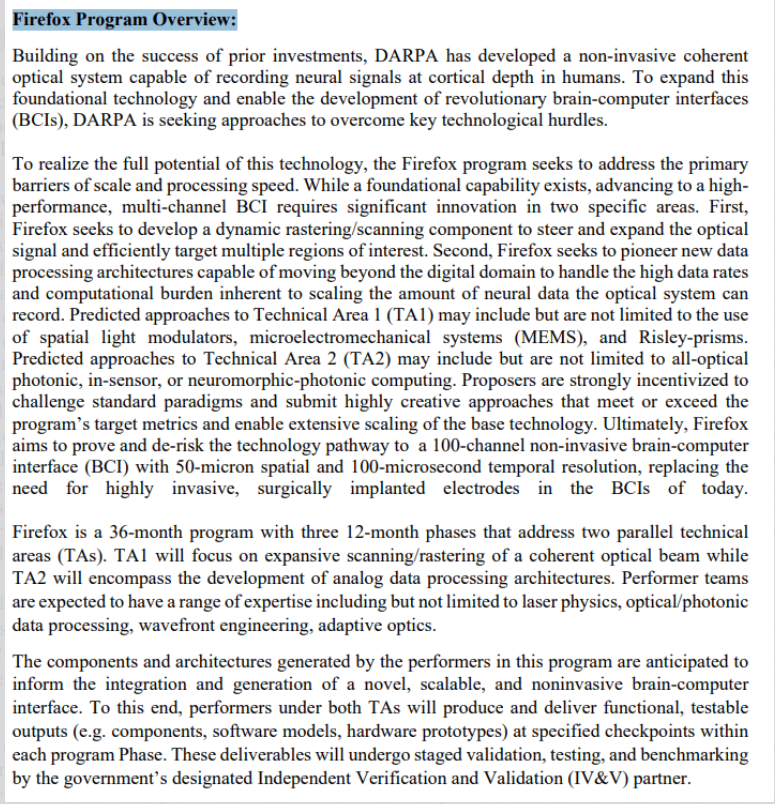
According to DARPA’s program description, building upon its prior investments, the agency has developed a non‑invasive coherent optical system capable of recording neural signals originating from deep within the human cerebral cortex.
Yet capturing neural signals is only the first step. For such technologies to evolve into high‑performance brain‑computer interfaces, a more practical challenge emerges: as the system gains the capacity to observe an increasing number of brain regions simultaneously and generate mounting volumes of neural data, how can rapid scanning be achieved? How can coverage be expanded? And how can such massive data streams be processed in real time?
These are precisely the kinds of problems Firefox aims to address. DARPA distills the core technical challenges down to two primary thrusts.
First, expand the optical system’s brain‑scanning capabilities.
Firefox seeks to develop a dynamic grating scanning component to steer and expand optical signals, enabling the system to probe multiple regions‑of‑interest in the brain with higher efficiency. This means future non‑invasive optical brain‑computer interfaces will no longer focus solely on confined areas, but could potentially cover much broader swathes of the cerebral cortex simultaneously.
The nervous system itself constitutes a highly distributed information‑processing network. Complex functions such as motor control, vision, language, attention and decision‑making are rarely performed by a single brain region in isolation. If the system can only read out signals from a limited set of regions, the dimensionality of information it can capture will inevitably be constrained.
Therefore, expanding brain‑region coverage essentially increases the "neural information bandwidth" accessible to the brain‑computer interface.
Second, address real‑time computation for massive volumes of neural data.
With expanded scanning coverage, another bottleneck emerges: data.
More brain regions, higher sampling rates and additional channels mean neural data volume can surge dramatically. Relying entirely on conventional digital computing architectures for processing may impose constraints on computation speed, power consumption and real‑time performance.
Therefore, another key mission of Firefox is to explore novel data‑processing architectures that transcend conventional digital computing frameworks, to cope with the data rates and computational workloads generated by substantially enhanced optical neural recording systems.
What DARPA describes as “breaking out of the digital domain” does not simply mean building a faster chip. Instead, it may involve new computing paradigms such as quantum computing, neuromorphic computing, and even biocomputing, where biological systems are harnessed to perform information‑processing tasks.
In other words, Firefox seeks to address challenges on both ends of the brain‑computer interface:
on one end: how to capture greater volumes of neural information from an expanded set of brain regions;
on the other end: how to process this information with sufficient speed.
If both capabilities can be enhanced concurrently, then a core bottleneck confronting non‑invasive brain‑computer interfaces — neural information bandwidth — could be further unlocked.
Why is it named “Firefox”?
This pop‑culture‑infused program name has also drawn outside attention.
One intriguing interpretation is that it may pay homage to Firefox, the 1982 sci‑fi thriller starring Clint Eastwood. The film was adapted from the eponymous novel published in 1977. In the story, the Soviet Union secretly develops an ultra‑advanced MiG‑31 fighter jet. Capable of flying at extreme speeds and evading radar, it is most notably equipped with a weapons system controlled directly by the pilot’s thoughts.
Per the film’s premise, once the pilot identifies a target, no button manipulation is required. Merely by forming the corresponding mental commands, the system can direct the weapons to lock onto and engage the target.
Hence, after DARPA unveiled Firefox, users on X joked that the agency appeared to be attempting to turn the “thought‑controlled weapons” from the 1982 film into reality.
Of course, real‑world Firefox still differs vastly from the sci‑fi premise in the film. Even so, this association — from the program name to its research focus — carries strong symbolic meaning: enabling higher‑speed, more direct information exchange between the human brain and complex machinery is gradually moving beyond science‑fiction narratives and into real‑world engineering research.
The technical point of contact for the Firefox program is Dr. Pedro Irazoqui, DARPA Program Manager.
It is worth noting, however, that Firefox is not DARPA’s only recent new project focused on the brain. Earlier this month, DARPA also announced it would host a virtual information briefing for another neurotechnology initiative codenamed SHINE.
If Firefox focuses on better “reading out the brain”, SHINE goes a step further — it seeks to investigate how to actively modulate the state of brain neural circuits.
02
SHINE: From Neural‑Signal Readout to Neural‑Circuit Remodeling
SHINE stands for Selective Harnessing of Intrinsic Neuroplasticity Engineering. Its core goal is to leverage the brain’s innate neuroplasticity mechanisms to develop next‑generation neuromodulation technologies. DARPA will host a related virtual information briefing on August 25.

Unlike conventional neural stimulation, which merely alters the firing state of neurons, SHINE focuses on a more fundamental question:
Can certain specific neural circuits be precisely targeted, and with the brain’s own neuroplasticity, induce more lasting structural or functional changes within aberrant neural networks?
DARPA aims to lay the groundwork for a new class of therapeutic technologies in the future, enabling the natural recovery and repair of dysfunctional neural circuits while minimizing disruption to normal brain function.
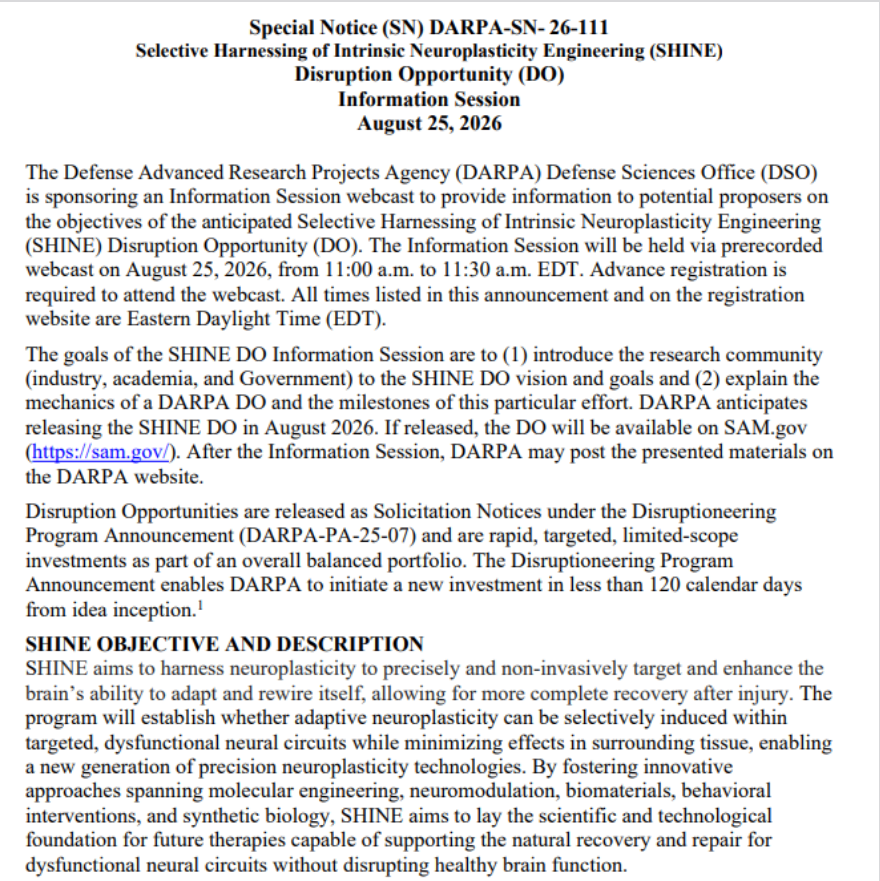
To achieve this goal, SHINE covers an extensive range of technical pathways, spanning synthetic biology, molecular engineering, neuromodulation and many other fields.
One notable area of interest is the relationship between psychedelic compounds and neuroplasticity.
Psychedelics represented by compounds such as psilocybin are believed to hold potential for boosting neuroplasticity. As early as 2019, DARPA launched relevant pharmaceutical‑research programs aiming to identify novel psychoactive drugs for the treatment of post‑traumatic stress disorder, depression, anxiety and substance use disorders.
However, the challenges are equally apparent. Conventional psychedelics tend to act on multiple neurotransmitter receptors and receptor subtypes simultaneously and lack sufficient targeting specificity. Consequently, they may activate numerous signaling pathways at once and produce prominent side‑effects such as hallucinations.
Such unpredictability is clearly unacceptable for military medical scenarios.
Hence comes a more challenging research direction: is it possible to retain the therapeutic effect of boosting neuroplasticity, while stripping away consciousness‑altering and hallucinogenic effects to the greatest extent possible?
This is in fact one of the new‑generation neurotechnology philosophies embodied by SHINE: moving away from the relatively crude modulation of global brain states toward far more precise regulation of specific molecules, cells, brain regions and neural circuits.
From Molecules to Brain Regions: DARPA’s Search for More Precise “Brain Control Knobs”
Beyond synthetic biology, another key thrust of SHINE is neuromodulation — the use of external means to alter information transmission and activity patterns within the nervous system.
Relevant technologies may include non‑invasive neural interfaces that act on the nervous system via different forms of physical energy such as sound, light or magnetic fields.
A notable example is DARPA’s earlier AWARE (Alert WARfighter Enablement) program. The program sought to apply near‑infrared light to the human body, with the ultimate goal of establishing a mechanism capable of turning specific drug effects on or off as needed.
These studies share a common ground with SHINE: both seek to identify more precise modalities for neural intervention.
Many past neuromodulation technologies functioned much like a relatively coarse “knob” to alter the excitatory state of brain regions. What DARPA now aims to achieve, by contrast, is arguably a far more sophisticated control system:
It must not only know where to stimulate, but also which cells and molecular pathways to target, when to deliver stimulation, and how to sustain induced changes for a sufficient duration.
The ultimate goal is not merely to transiently alter neural activity, but rather to leverage neuroplasticity to drive the reorganization of aberrant neural circuits.
If SHINE eventually evolves into a fully funded research program, DARPA expects it to lay the scientific and technical foundation for future novel neurotherapies, enabling the recovery of dysfunctional neural circuits without impairing normal brain function.
03
DARPA Advances “Brain‑Reading” and “Brain‑Modifying” Capabilities in Parallel
Over the past several decades, DARPA has sought to understand and harness the human nervous system to help warfighters recover more rapidly from injury, fatigue, extreme environments and psychological stress, while sustaining higher levels of cognitive and motor performance.
One key signal emanating from both Firefox and SHINE is:
The focus of neurotechnology competition in the next phase may no longer be merely “whether we can interface with the brain”, but instead whether we can read the brain at higher bandwidth, interpret the brain with greater precision, and ultimately influence the brain in a far more controllable manner.
In this sense, Firefox and SHINE do not represent two isolated DARPA programs. Instead, they illustrate the two emerging main threads of next‑generation neurotechnology: one continuously boosts the information bandwidth between humans and machines, while the other advances the spatial, temporal and biological precision with which humans can intervene in the nervous system.