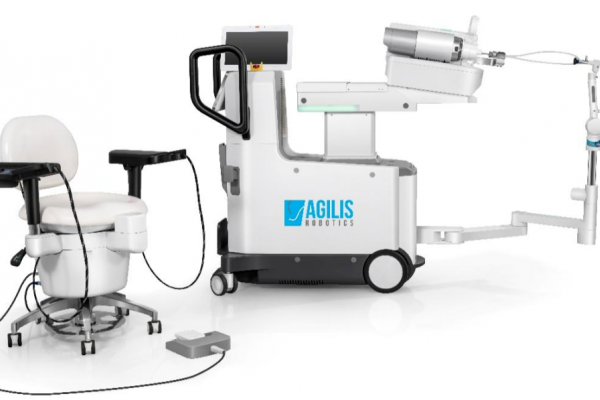
Recently, the U.S. has launched a landmark collective research program on autonomous surgical robots.
The Advanced Research Projects Agency for Health (ARPA‑H), under the U.S. Department of Health and Human Services (HHS), has officially released the list of contracted teams for the AIR (Autonomous Medical Interventions and Robotics) program. It has awarded R&D contracts to a total of seven industry‑university‑research teams, with Philips and Siemens Healthineers among the awardees.
The program targets thrombectomy robots, with plans to provide up to $175.3 million in funding to contracted teams over a five‑year period.


Time is of the essence for stroke care. Data shows that every 10‑minute delay in treatment translates to an additional 39 days of disability for patients and roughly $10,000 in extra healthcare costs. Nevertheless, a real‑world challenge persists: half of the U.S. population lives more than one hour’s drive from a comprehensive stroke center capable of performing mechanical thrombectomy. Among the approximately 335 000 patients annually with large‑vessel occlusion stroke who meet surgical eligibility criteria, only 12% receive thrombectomy.
The core vision of the AIR program is to develop autonomous interventional robots that do not require continuous real‑time manual physician control, enabling community‑level hospitals to perform curative stroke procedures that were previously only achievable at top‑tier medical centers.
The program targets two primary technical thrusts: TA1 Autonomous Robotic Systems and TA2 Microrobots. Within 24 months, all teams must demonstrate autonomous functionality on either benchtop models or biological phantoms. By the 60‑month milestone, full end‑to‑end autonomous surgical intervention demonstrations shall be completed using simulation models, animal subjects, or human cadavers. These deliverables serve as the key metrics for funding disbursement.
The autonomous vascular robotic system under Technical Area 1 (TA1) is geared toward the widespread adoption of stroke thrombectomy procedures. Five organizations have been selected for this track, with a focus on developing robotic systems capable of independently performing partial or even full interventional‑surgical manipulations.
Siemens Healthineers
It is tasked with developing an autonomous endovascular surgical system by repurposing existing commercial‑off‑the‑shelf components, integrating fluoroscopic imaging, and building navigation algorithms grounded in physical models and reinforcement learning. Leveraging a mature commercial hardware foundation, the effort aims to lower the engineering‑implementation barriers for deploying autonomous systems.
Philips North America LLC
It will leverage its mature image‑guided therapy platform, paired with multi‑channel fluid‑driven steerable catheters, and incorporate imitation‑learning algorithms to build a dexterous autonomous interventional surgical robot, drawing on its accumulated expertise in image‑guided interventional platforms.
Magnendo
It will develop a magnetically‑driven autonomous endovascular robot. The system relies on externally controlled magnetic fields to propel the guidewire through blood vessels, and integrates pre‑operative imaging with intra‑operative real‑time scanning for in‑vivo device localization, addressing the pain point of hard‑to‑reach tortuous intracranial vascular pathways.
University of California, San Diego (UCSD)
It will develop a flexible “growing robot”. The robot body can autonomously extend and advance along the vascular lumen to reach the brain and perform mechanical thrombectomy.
Kitware
Serving as a public technical‑support partner, it will build a unified virtual simulation and validation test platform for the four aforementioned robots in the TA1 track. All simulation data and software code generated by the platform will be publicly released, helping other industry players streamline regulatory‑validation workflows and cut overall R&D costs across the track.
The TA2 track focuses on microrobots. Its goal is to break free from the constraints of large specialized equipment to enable less‑invasive in‑vivo operations. Two universities have been selected for this track.
Stanford University
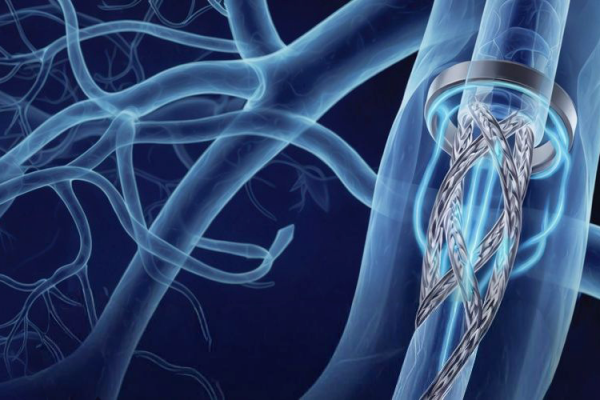
It will advance the clinical translation of the cable‑free magnetic helical vascular device M3bot. Designed specifically for ischemic stroke, this microrobot is capable of autonomously ablating, grasping, and retrieving thrombi.
University of California, Berkeley (UC Berkeley)
It will develop a five‑segment microrobot about the size of a pen cap, equipped with a magnetically‑driven pump and micro‑hydraulic suction feet. Capable of crawling inside the human body to perform sinus tissue sampling, it can also travel within the intracranial cerebrospinal‑fluid pathways to relieve intracranial hypertension.

Among the awardees under this contract, Philips and Siemens Healthineers stand out as the most closely‑watched participants.
Let us start with Philips, a company with extensive participation in such collaborative research initiatives. According to Medical Device Home, back in March 2026, the European SHERPA consortium coordinated and led by Philips had already entered the critical clinical‑validation phase.
SHERPA is a large‑scale European interventional‑robotics project jointly carried out by multiple European countries. It brings together companies including Medtronic, Barco and Sim&Cure, alongside several top‑tier European medical‑research institutions. Seven clinical studies are being conducted focusing on minimally‑invasive interventions for brain aneurysms and liver tumors. Philips takes charge of overall system integration, imaging platform development and AI algorithm development, exploring the transition of interventional surgery toward precision medicine.
Siemens Healthineers, by contrast, previously underwent a strategic pullback in the vascular‑interventional robotics space. The company once owned the CorPath GRX interventional robotic platform; however, in May 2023, it announced the halt of commercial roll‑out for the platform’s cardiac coronary business and exited the vascular‑interventional robotics track. The move was widely interpreted within the industry as a landmark event reflecting headwinds facing the commercialization of interventional robots.
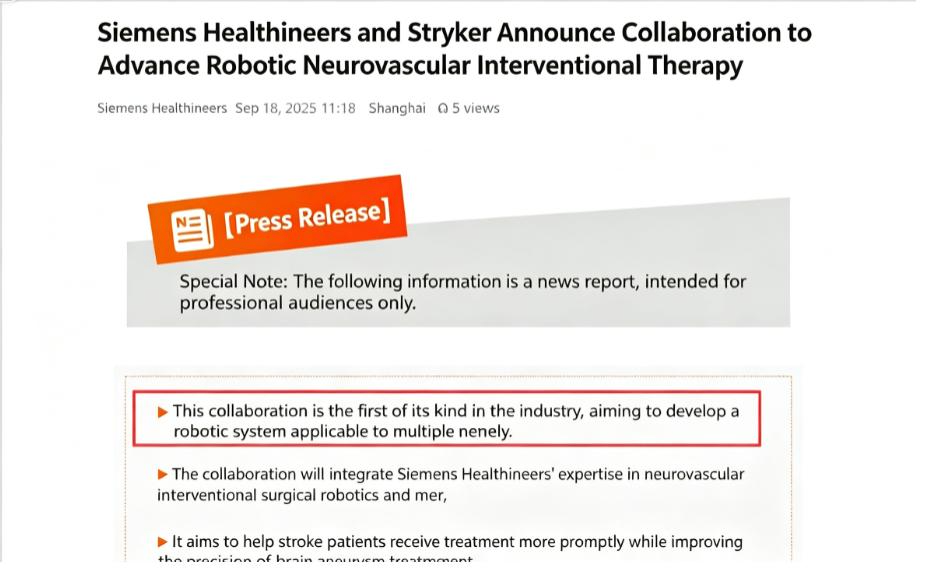
In fact, Siemens Healthineers has continued its engagement in interventional‑robotics projects through partnerships ever since. One well‑known case dates to September 2025, when Siemens Healthineers and Stryker, a leader in neurointervention, announced a strategic cooperation. The two parties jointly develop neurovascular interventional surgical robots with a focus on neurointerventional scenarios such as stroke and aneurysms. Its award of the ARPA‑H AIR program represents yet another move by Siemens Healthineers to re‑enter the autonomous vascular‑robotics track.
In addition, Magnendo, a name largely unknown to the general public but with considerable potential on this research roster, stands out as a dark horse in the field of magnetically‑controlled interventional robotics.
The company was spun out of Professor Xuanhe Zhao’s research team at the Massachusetts Institute of Technology (MIT). Its founder, Yoonho Kim, is the core technical inventor, making it a hard‑tech venture incubated by MIT.
The vast majority of vascular‑interventional robots available on the market are essentially motor‑driven roller mechanical structures. They mimic physicians’ hand motions to push, pull and rotate guidewires. The distal steering of instruments still relies on torque transmission and pre‑shaping of the guidewire itself. When navigating highly tortuous intracranial blood vessels, such systems frequently struggle to reach target sites, prolonging the duration of thrombectomy procedures.
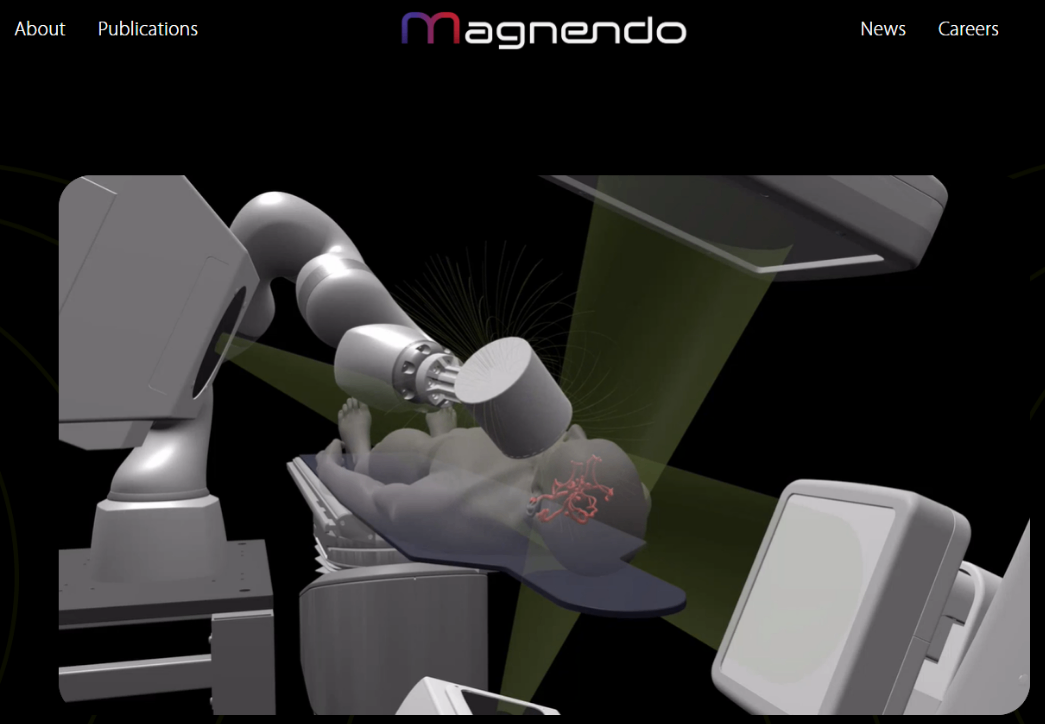
Magnendo follows a fundamentally different technical approach: rather than mechanically replicating manual human movements, it directly and actively controls the trajectory of the guidewire tip via external magnetic fields. Its flagship product, the Robo‑thread magnetically‑controlled soft guidewire, is designed to address navigation challenges in anatomically‑complex access paths such as the aortic arch, carotid siphon, and multi‑level intracranial bifurcations, with the goal of cutting down procedural time.

In the fields of vascular intervention and autonomous surgical robotics, substantial ongoing investment has been seen in recent years from both ARPA‑H in the United States and the EU’s Horizon Europe programme. Led by governmental agencies, large enterprises, start‑ups and universities carry out joint research and development efforts.
This is largely driven by practical‑market demands. Both in the United States and Europe, there is a shortage of highly‑skilled physicians specializing in neurointervention and complex vascular intervention. A large number of patients in remote areas lack access to advanced emergency interventional procedures.
Second, collaboration offers a shortcut to solving complex challenges. A fully‑autonomous surgical robot is not a standalone product. It requires synergy across imaging, robotic control, in‑vivo localization, simulation‑based validation and regulatory standards. No single enterprise can easily cover the entire value chain on its own, calling for industry‑academia‑research collaboration to share risks.
In fact, such conditions also exist in China, where the demand is even greater. China bears one of the world’s heaviest stroke burdens, with more than 2.5 million new cases of ischemic stroke annually. There is a substantial shortage of neurointerventional physicians, and grassroots‑level treatment capacity remains inadequate.
When it comes to domestic Chinese enterprises, Wansi Medical (EduRobot) was spun out from the research team led by Professor Li Youxiang, an expert from Beijing Tiantan Hospital. Focused on cerebrovascular interventional robotic systems, it represents one of the faster‑moving industrialization projects among China’s neurointerventional robot developers.R‑ONE, a vascular interventional robot under MicroPort, has obtained marketing approval. It is one of China’s early commercialized pan‑vascular interventional robotic platforms.ETcath, the interventional robot developed by Vimed Medical, has also secured regulatory clearance. Notably, Vimed Medical’s interventional robot is the world’s first commercially‑launched product equipped with force‑feedback functionality.
In addition, Chuangjie Medical, incubated by the Shenzhen Institute of Artificial Intelligence and Robotics, has developed the “Chuangjie Shenci” magnetically‑controlled neurointerventional robot. It manipulates magnetic guidewires via external magnetic fields to address target‑access challenges within tortuous intracranial blood vessels. Its technical approach benchmarks that of Magnendo under the AIR program, and the system is currently in the pre‑clinical R&D phase.
In the field of in‑vivo microrobots, the research team led by Professor Feng Lin from Beihang University has developed degradable magnetically‑controlled nanoscale thrombolytic microrobots. At nanometer‑scale dimensions, these devices can be intravenously injected into blood vessels. After completing thrombus ablation, they can degrade and be metabolized spontaneously inside the body. Large‑animal thrombolysis experiments have already been completed.
China’s current mainstream products are all physician‑operated tele‑manipulated assistive robots. Their core value lies in radiation shielding and improved operational precision, representing a generational gap from the fully‑autonomous surgical goals pursued by the AIR program.