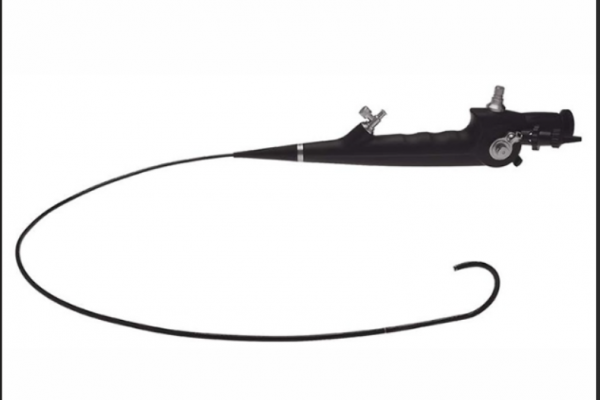
On August 10, 2026, foreign‑media reports stated that Shanghai Jieti Medical Technology Co., Ltd. is developing a blood‑vessel‑implantable brain‑computer interface. Citing the introduction delivered by Zhao Zhengtuo, co‑founder of Jieti Medical, at the Global Healthcare Summit in Hong Kong, the device is delivered via the jugular vein and travels through blood vessels to the brain without requiring craniotomy. Duan Wanru, a physician at Xuanwu Hospital, remarked that experienced practitioners are expected to complete the implantation in roughly ten minutes in the future.
Up to now, Jieti Medical has not released the product model, experimental data or development roadmap. The 10‑minute implantation duration mentioned in media reports serves as an expected target rather than a surgically validated time from human trials. Though this technique dispenses with craniotomy, it remains an interventional procedure consisting of jugular vein puncture, catheter‑based navigation, cerebral vessel‑wall penetration and electrode implantation.
Jieti Medical’s intravascular‑based technology is backed by previously published research. In November 2024, the team led by Zhao Zhengtuo and Li Xue, together with Professor Yang Zhigang’s research group from Zhongshan Hospital, Fudan University, published a paper in Nature Communications introducing uFINE‑I, an ultra‑flexible neural electrode delivered via blood vessels.
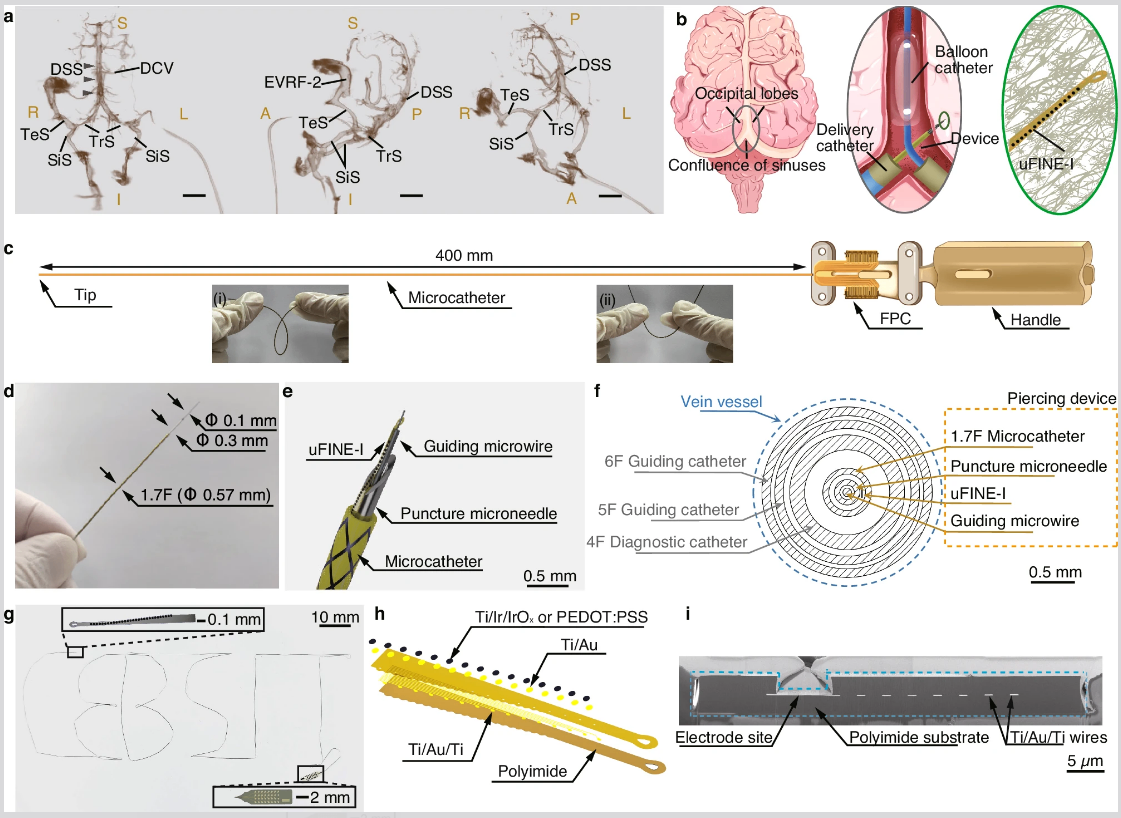
During sheep‑based experiments, researchers guided the catheter through the jugular vein into the intracranial venous system, penetrated the blood‑vessel wall near the confluence of sinuses, and implanted electrodes into the brain tissue of the occipital lobe. The implanted electrodes captured local field potentials and multi‑channel single‑neuron spike signals. Imaging and histological results presented in the paper revealed minor tissue injury and mild immune responses triggered by the experiment.
This solution differs from Synchron’s Stentrode. The Stentrode stent‑mounted electrode stays inside the cerebral blood vessel and picks up brain‑wave signals across the vessel wall. By contrast, Zhao Zhengtuo’s team navigates inside the blood vessel before penetrating its wall and inserting the ultra‑flexible electrode straight into brain tissue to acquire signals at the single‑neuron level.
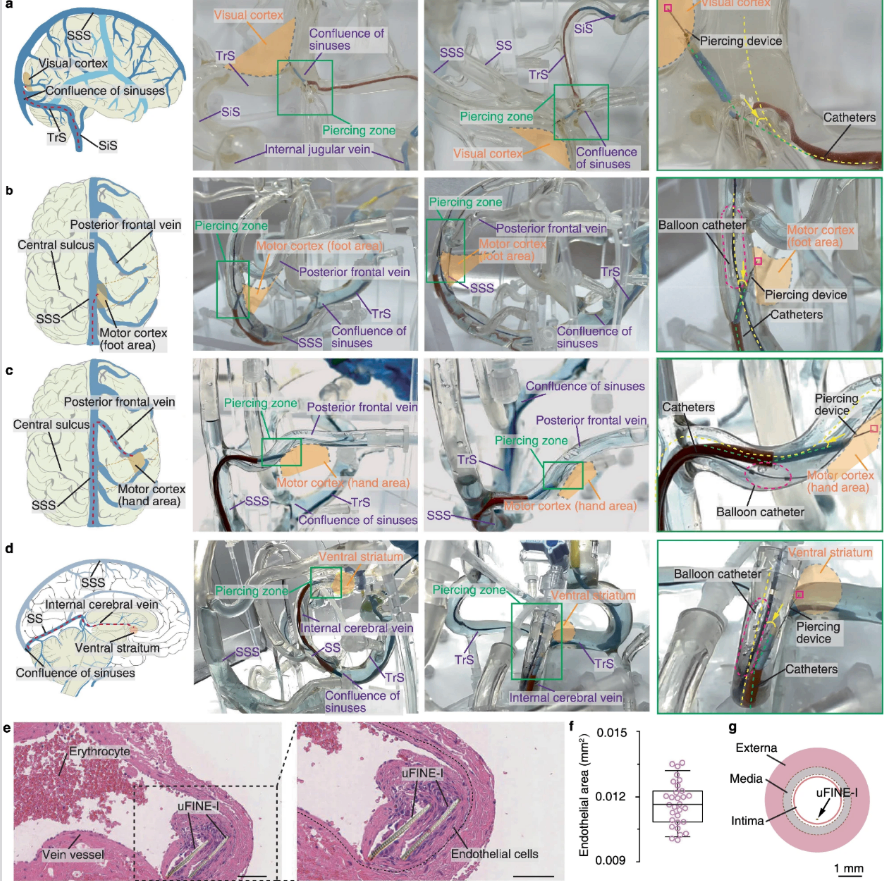
Foreign‑media outlets described the device as being placed outside blood vessels without penetrating brain tissue, which conflicts with the technical descriptions in relevant papers and patents. Documents indicate that this approach requires puncturing the vascular wall and implanting electrodes into the targeted brain region.
Zhao Zhengtuo, Li Xue and other members filed the relevant patent applications in 2022. Its European family patent published in 2025 covers structures for catheter positioning, blood‑vessel‑wall puncture, electrode delivery and puncture‑site sealing. Public patent databases list Shanghai Jieti Medical as one of the applicants or patent‑holders.
In December 2025, the Institute of Neuroscience, Center for Excellence in Brain Science and Intelligence Technology, Chinese Academy of Sciences announced that its "high‑performance minimally‑invasive interventional brain‑computer interface" project, jointly developed with Zhongshan Hospital Fudan University and Jieti Medical, won an award in the brain‑machine‑system championship of the 2025 National Disruptive‑Technology Innovation Competition. According to official descriptions, this solution enables single‑neuron activity recording without craniotomy.
It can be concluded that Jieti Medical has taken part in research on interventional brain‑computer interfaces. Previously, relevant information was mainly released by research institutions via papers, patents and project briefings. The company has not independently disclosed the research‑and‑development progress of its interventional‑type product, nor announced new plans for animal or human trials.
The interventional solution is not the product currently undergoing human‑subject trials at Jieti Medical. The company’s present‑day clinical system adopts an ultra‑flexible invasive technical route. A tiny hole measuring 3 to 5 millimetres is drilled into the skull, flexible electrodes are implanted into the motor cortex, and the wireless implant is embedded inside the skull. Although this technique reduces the size of the skull opening, an implantation passage still needs to be established directly through the skull.
On March 25, 2025, in collaboration with the Center for Excellence in Brain Science and Intelligence Technology of the Chinese Academy of Sciences and Huashan Hospital Affiliated to Fudan University, Jieti Medical completed China‑first prospective clinical trial for the long‑term human implantation of an invasive brain‑computer‑interface system. The subject lost all four limbs in a high‑voltage electrical accident and was fitted with a 64‑channel BCI system.
The implant of this system has a diameter of around 26 mm and a thickness of less than 6 mm. Two ultra‑flexible electrodes are inserted into the brain tissue through micro‑holes on the skull, and the surgical procedure lasts for over one hour. After several weeks of training, the participant was able to control the computer cursor by mind and carry out operations such as car‑racing and gobang. No infection or electrode failure was reported during the early‑stage follow‑up. Details of the first‑ever trial
In June 2025, the team implanted the WRS01 system into a patient suffering from high‑level paraplegia caused by spinal‑cord injury. The patient was subsequently able to operate an electric wheelchair and a quadruped robot via brain‑wave signals, and complete online data‑labelling tasks with a mind‑controlled cursor. By January 2026, three patients with limb amputation or high‑level paraplegia had received the team‑developed ultra‑flexible neural electrodes. Recent Clinical Progress
In early 2026, with its self‑developed surgical robot, Jieti Medical completed the clinical implantation of WRS02, its 256‑channel wireless high‑throughput invasive brain‑computer‑interface system intended for regulatory registration, and conducted verification of brain‑controlled interaction. The company plans to launch multi‑center registrational clinical trials in mid‑2026.
Apart from the brain‑control system designed to operate computers and external devices, Jieti Medical is also developing a closed‑loop deep‑brain‑stimulation system. The company revealed that implants for four clinical‑study subjects have been finished, and follow‑up clinical research targeting Parkinson’s disease, epilepsy and other illnesses is scheduled.
Founded in 2021, Jieti Medical mainly engages in the research and development of minimally‑invasive implantable brain‑computer interfaces. Its technology portfolio covers ultra‑flexible micro‑nano electrodes, wireless implants, neural signal acquisition systems, decoding algorithms and implantation surgical robots. The business focuses on brain‑machine control and neuromodulation.
In March 2026, Jieti Medical secured CNY 500‑million strategic financing led by Alibaba Group, with SDIC Chuanghe as the co‑investor. Existing investors including Tencent, Qiming Venture Partners, Lilly Asia Ventures, Source Code Capital and Shanghai State‑owned Investment Pilot Fund made follow‑on investments. The company's total financing over the past year has exceeded CNY 1.1‑billion.Financing and Product Updates
According to available public documents, Jieti Medical’s research on interventional‑type technology predates the latest media reports. Its research team filed patent applications in 2022, published a paper on sheep experiments in 2024, and entered its interventional brain‑computer‑interface project into a technology competition in 2025. Foreign‑media reports newly put forward the 10‑minute implantation target without supplying fresh experimental data.
Multiple validations remain necessary before this technology can be applied to human beings, including the stability of intracranial venous navigation and vascular‑wall puncture, as well as risk assessments for hemorrhage, thrombosis, embolism and puncture‑site sealing. Long‑term electrode fixation, signal stability and electrode retrieval methods also require further research.
What can be confirmed at this stage is that the research team involving Jieti Medical has accomplished intravascular delivery and trans‑wall implantation of ultra‑flexible electrodes in sheep models and recorded single‑neuron signals. The product‑development phase of the interventional scheme, human‑trial arrangements and the 10‑minute implantation target await further announcements from the company or its research group.