On August 12, 2026, tricuspid‑valve interventional device developer Versa Vascular announced two major updates. Bill Shields, a seasoned veteran in structural‑heart business from Medtronic, officially took office as Chief Executive Officer.The company also secured an additional USD 15‑million in its Series‑C round, bringing the total committed capital of this financing to USD 42‑million (approximately 280‑million‑yuan).The newly‑raised funds will support the ongoing first‑in‑human clinical trials for its AdapTR tricuspid‑valve repair system outside the United States, the planned early‑stage feasibility study in the US, and follow‑up product‑development work.
#Series‑C Funding Rises to USD 42‑Million, With Capital Continuously Focused on Clinical‑Stage Development
Founded in 2020, Versa Vascular was spun‑out from local med‑tech incubator Occam Labs. Its founding team boasts extensive experience in the research and development of structural‑heart catheters and implants. At present, the company prioritises the minimally‑invasive interventional therapy for tricuspid regurgitation for its research‑and‑development work.
Versa has secured an additional USD 15‑million in the current financing round, bringing the total committed capital of its Series‑C financing to USD 42‑million.
This financing constitutes a follow‑on expansion to the Series‑C round initiated in 2025.
According to public information from S3 Ventures, Versa announced the completion of its over‑subscribed $27.3‑million Series‑C financing in September 2025. The round was led by an existing strategic investor and S3 Ventures, with prior backers including Cadence Healthcare Ventures, View Ventures, BioStar Capital and Santa Cruz Ventures taking part in the investment. The company also appointed David Hovda as its CEO at that time.
At the time of its 2025 financing, Versa disclosed that it had completed its first‑in‑human clinical trial in 2024. The USD 27.3‑million proceeds were intended for the further advancement of its proprietary technology and the launch of early‑stage feasibility studies within the following year.
By August 2026, the purposes of the newly‑added USD 15‑million financing have been further clarified. As disclosed by the company, the funds are mainly allocated to three areas:
Continue to support the first‑in‑human clinical research of AdapTR conducted outside the United States;
Support the early‑stage feasibility study in the United States;
Support further‑downstream product‑development initiatives
It can be observed from two successive rounds of public filings that Versa’s funds are heavily dedicated to the clinical advancement of AdapTR.The USD 27.3‑million financing secured in 2025 mainly went toward ongoing product development and preparations for early‑stage feasibility research. Following the follow‑on financing in 2026, the company has explicitly included the U.S.‑based early‑stage feasibility study as one of its fund‑allocation priorities.
Versa’s One‑Year‑Long Financing and Clinical Progress Milestones
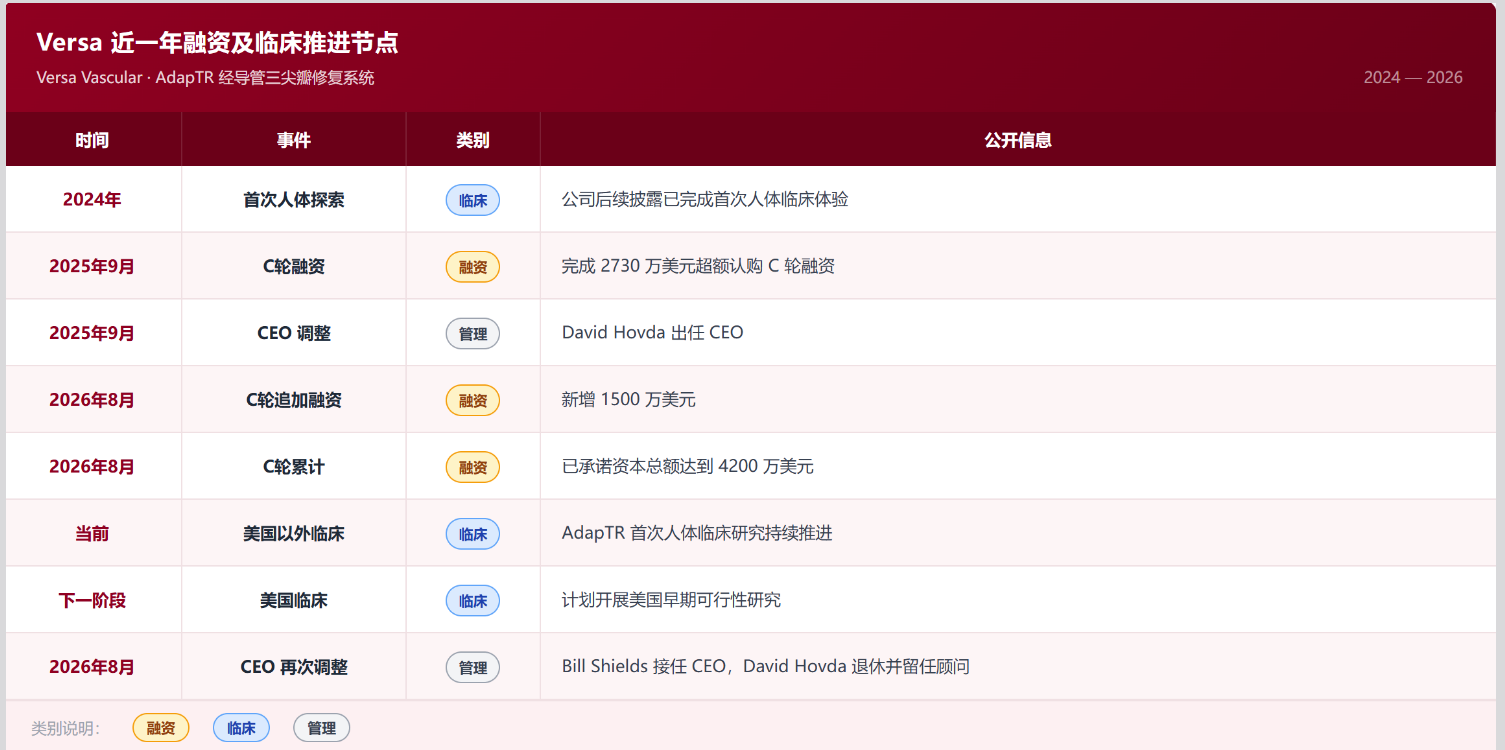
To‑date, the company has not disclosed the sample size, number of study sites, primary endpoints, patient baseline characteristics and full follow‑up outcomes of its ongoing first‑in‑human clinical trial. It has also yet to announce the official launch date and planned enrollment scale for the U.S. early‑stage feasibility study.
Accordingly, AdapTR remains a product under clinical‑stage development, and further data are required to verify its clinical safety and efficacy.
# AdapTR targets tricuspid‑valve repair, with its implant device situated entirely inside the right atrium.
The AdapTR system developed by Versa is designed for the minimally‑invasive treatment of severe tricuspid regurgitation, adopting the transcatheter tricuspid‑valve‑repair technical route.
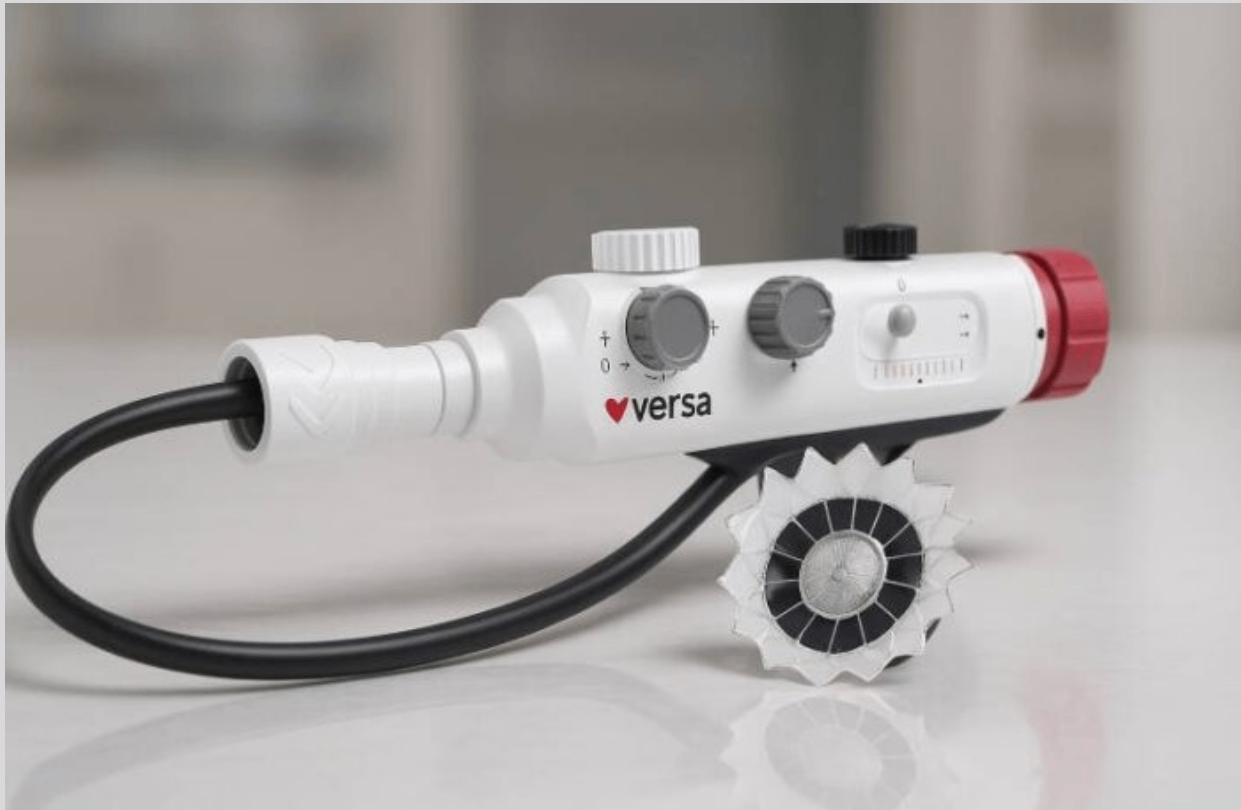
As disclosed by the company, the AdapTR system consists of an implant and a delivery system. The implant is engineered to support the function of native valve leaflets, while the delivery system enables stable, precise implantation and repositioning of the device.
Versa has provided a detailed description of its structure. The implant sits entirely within the right atrium and features a low‑radial‑force design that prevents interaction with subvalvular structures. Working in tandem with the patient’s native leaflets, the implant improves blood flow across the tricuspid valve. The delivery system permits physicians to re‑position the implant for optimal procedural outcomes.
The original financing announcement also identifies implant manipulation, repositioning capability and intracardiac device positioning inside the atrium as key design features of the technology. It also states that intra‑atrial device positioning can simplify intraoperative imaging‑related operations.
These designs need to be interpreted against the current competitive landscape of transcatheter tricuspid‑valve interventions.
At present, transcatheter tricuspid‑valve interventions mainly fall into two major categories: repair and replacement. Multiple device‑design approaches exist within the repair track. AdapTR is designed to preserve the function of the patient’s native tricuspid valve and modulate valve operation via an implant deployed inside the right atrium.
Its subsequent clinical validation needs to address several straightforward questions: to what extent the implant can reduce tricuspid regurgitation and whether the improvement can be sustainably maintained; the safety performance brought by the intra‑right‑atrium placement and low‑radial‑force design; whether the repositioning function can raise the device implantation success rate; and whether the company‑highlighted simplified imaging workflow can actually cut down operation duration and lower the difficulty of imaging‑based manipulation.
The company has yet to release complete public‑available clinical data for these indicators, so quantitative evaluation cannot be carried out at the current stage.
# Two products have secured FDA approval, reshaping the competitive barriers within tricuspid‑valve intervention.
The timeline for AdapTR to advance its U.S.‑based clinical trials differs from the early days of tricuspid‑valve interventions when no commercialized devices were available.
Two tricuspid‑valve interventional devices won FDA approvals successively in the United‑States market in 2024, representing transcatheter tricuspid‑valve replacement and transcatheter edge‑to‑edge repair respectively.
The EVOQUE tricuspid‑valve replacement system from Edwards Lifesciences secured FDA approval in February 2024, followed by Abbott’s TriClip G4 tricuspid‑valve repair system in April 2024.
This means that when Varex advances AdapTR in the United States in the future, it will face well‑defined benchmarks: transcatheter edge‑to‑edge repair on one end and transcatheter tricuspid‑valve replacement on the other.
Comparison of Three Technical Routes for Tricuspid‑Valve Intervention
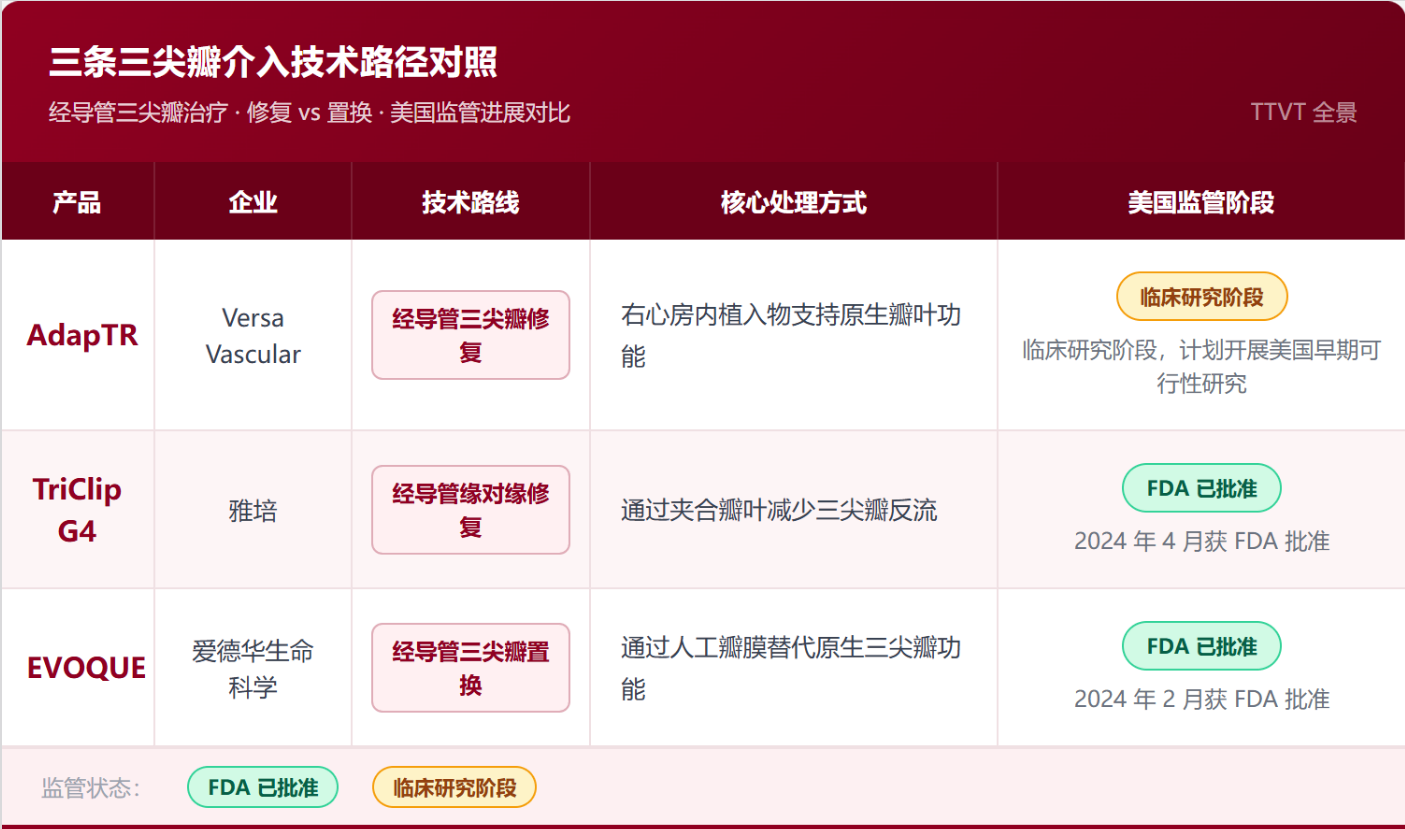
TriClip and EVOQUE stand for the two solutions that have completed U.S. regulatory validation, which means late‑comers are required to design trials within a well‑defined clinical landscape.
The publicly‑disclosed product features of AdapTR include native leaflet‑function support, an implant confined entirely to the right atrium, low radial force, zero interaction with subvalvular structures, reposition‑enable design and intra‑atrial device positioning.
These engineering designs ultimately need to translate into quantifiable clinical indicators, including device success rate, residual tricuspid regurgitation severity, major adverse events, procedure duration, re‑intervention rate and medium‑to‑long‑term durability.
Varex has not yet released sufficient public‑available data for direct‑dimension comparisons between AdapTR and the existing transcatheter repair and replacement devices in the above‑mentioned aspects.
# A seasoned veteran from Medtronic’s structural‑heart division takes over, with clinical‑development expertise serving as the core determining factor
Beyond financing, the more noteworthy change this time lies in another reshuffle of Varex’s chief‑executive‑officer position.
Bill Shields spent 15 years working in Medtronic’s structural heart business, most recently serving as Vice‑President and General Manager for the company’s transcatheter mitral and tricuspid therapy division.
Shields dedicated seven‑year‑long years to the field of transcatheter mitral and tricuspid valves, overseeing product development and heading multiple clinical trials.
Earlier in his career, he handled front‑end and back‑end marketing work for Medtronic’s transcatheter programmes. Prior to joining Medtronic, Shields worked as a senior engineer at Stryker. His professional background is highly aligned with the challenges Varex now needs to tackle.
AdapTR has entered the first‑in‑human study phase and will next advance early‑stage feasibility trials in the United States. For start‑ups engaged in structural‑heart devices, this stage covers multiple links including clinical‑trial design, operator training, site management, product iteration and subsequent regulatory pathways.
The transcatheter mitral and tricuspid valve business previously managed by Shields at Medtronic sits on a key track for structural‑heart technology development. The direct recruitment of the business lead from the large‑scale medical‑device firm enables Varex’s management team to become better‑aligned for the clinical‑development phase.
Former CEO David Hovda will retire and continue to serve as a corporate consultant.
Hovda also boasts management experience within medical‑device enterprises. According to information previously released by S3 Ventures, he once served as CEO of Innovein and President and CEO of Simplify Medical. During his tenure at the latter firm, he witnessed its FDA approval and the subsequent acquisition by NuVasive.
Varex has accordingly carried out two distinct personnel restructurings within less than one year.
Following its financing round in 2025, the company brought in Hovda, who possesses expertise in medical‑device corporate management, FDA approvals and mergers‑and‑acquisitions. As it gets ready to expand its U.S.‑based clinical operations in 2026, Shields — a 15‑year veteran of Medtronic’s structural‑heart segment with long‑term oversight over transcatheter mitral and tricuspid valve businesses — has taken over the leadership.
Shields stated in the announcement that the company has observed encouraging clinical outcomes and is on track to expand its clinical programme into the United States. Nevertheless, Varex has not released the detailed clinical data backing this claim. Judgements on the clinical performance of AdapTR should remain confined to the company’s statements until sample size, follow‑up duration, regurgitation‑relief indicators and safety‑related findings are made public.
# Conclusion
Varex has now moved on to a more concrete verification phase.
Committed capital for Series‑C financing has reached 42 million US dollars. AdapTR is conducting first‑in‑human clinical trials outside the United States. The company plans to launch early‑stage feasibility studies in America. The newly‑appointed CEO boasts 15‑year working experience in Medtronic’s structural‑heart business, including seven years focused on transcatheter mitral and tricuspid‑valve sectors.
Meanwhile, two FDA‑approved products, TriClip and EVOQUE, are available for tricuspid‑valve interventional therapy in the United States. After AdapTR advances into U.S.‑based clinical trials, it will need to compete against the established benchmarks for repair and replacement‑based treatments.
Varex’s most‑critical information in the next phase will stem from the clinical trials themselves: the exact sample size and follow‑up findings of its first‑in‑human study, the degree of tricuspid regurgitation improvement, device‑ and procedure‑related safety data, the launch timeline for U.S. early‑feasibility studies, and whether its right‑atrium implantation and repositionable design can deliver distinct clinical benefits.
The company has yet to disclose the full‑set data mentioned above. The USD 42‑million financing and management reshuffle have secured capital and team deployment required for continued product development. Which patient groups AdapTR can ultimately target and its competitive standing will hinge on subsequent clinical data.