Philips has recently forged partnerships with six companies to expand its capabilities in wearable‑device and off‑hospital patient monitoring. These collaborations enable Philips to incorporate products from Blue Spark Technologies, Caretaker Medical, Cuviva, LifeSignals, Respiree and smartQare into its product portfolio, as it stakes its claim on the hundred‑billion‑dollar global Remote Patient Monitoring (RPM) market.

These partnerships expand the continuous patient‑monitoring functions that can be integrated into Philips’ systems. According to Sangdo Kim, Head of Philips’ next‑generation acute and transitional‑care monitoring product line, the collaborations are designed to help clinicians better monitor patients across diverse care settings.
These partnerships extend the range of continuous patient measurements integrable into Philips ecosystems, such as the Patient Information Center (PIC) iX. The cooperation covers the products listed below:
Blue Spark Technologies – The disposable wearable TempTraq patch enables continuous core‑body‑temperature monitoring. Clinically proven to detect fever at an earlier stage, it improves patient visibility and supports early‑stage intervention for both in‑patients and out‑patients.
Caretaker Medical – The VitalStream wearable solution provides continuous non‑invasive blood pressure and advanced hemodynamic monitoring to strengthen inpatient surveillance and clinical decision‑making.
As a core‑technology partner for the Hospital‑at‑Home platform, Cuviva delivers secure, advanced and fully‑integrated IT platforms. It enables structured and scalable hospital‑at‑home care via digital monitoring, real‑time communication, and seamless integration with Philips’ clinical workflows and hospital digital infrastructure.
LifeSignals’ UbiqVue multi‑parameter biosensor is a disposable, wireless, chest‑worn wearable device. It delivers continuous near‑real‑time monitoring of dual‑channel electrocardiogram, oxygen saturation, pulse rate, respiratory rate, body temperature, posture and movement. When paired with centralized software, the device enables alert‑based, scalable and proactive patient‑monitoring both in‑hospital and out‑of‑hospital settings.。
Respiree – The 1Bio™ Platform, 1Bio™ AI and RS001 wearable biosensor technology deliver continuous cardiopulmonary monitoring. The measurable indicators include patented direct‑read respiratory rate, other pulmonary physiological biomarkers, pulse, SpO₂, posture and activity, which facilitate the early detection of patient deterioration across various care settings.
smartQare – The viQtor and Healthdot wearable biosensor technologies enable continuous monitoring of pulse, respiration, SpO₂, skin temperature and activity, helping clinicians stay informed about patient conditions throughout care transitions.
These partnerships form part of Philips’ commitment to building an interoperable monitoring system. Philips believes the solution will allow healthcare systems to deploy and scale monitoring technologies tailored to their clinical and operational needs with greater flexibility. Philips’ expertise helps advance this objective by interconnecting patient‑related data from diverse medical institutions.

The global Remote Patient Monitoring (RPM) market is undergoing explosive growth. According to MarketsandMarkets forecasts, the market size will rise from USD 36.29 billion in 2026 to USD 66.33 billion in 2031, representing a compound annual growth rate (CAGR) of 12.8%.
Philips has long‑term made layouts for this promising hundred‑billion‑dollar market. After years of efforts, the company’s patient‑monitoring product lineup has built a full‑fledged closed‑loop system covering high‑sensitivity in‑hospital monitoring and at‑home post‑discharge rehabilitation.Besides, in Philips’ Q2 2026 financial report, the Connected Care business delivered standout performance. The segment posted a 2‑percent comparable sales growth, with its adjusted EBITA margin jumping sharply year‑on‑year to 17.8%, driven chiefly by operational optimization and productivity gains.
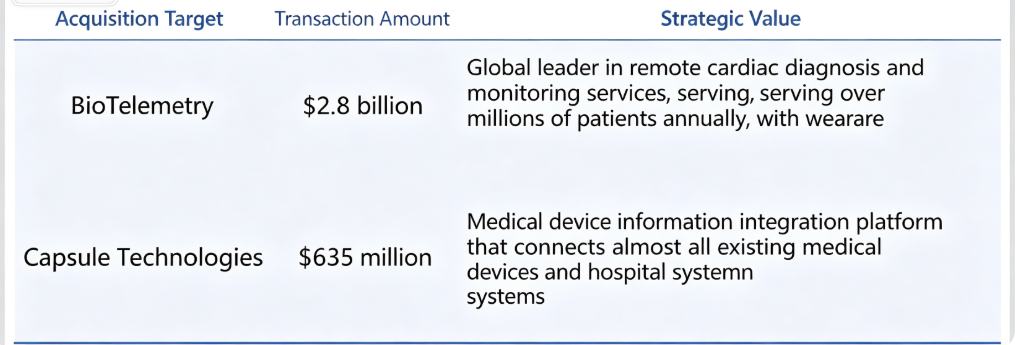
Philips laid the groundwork for its ambitions in the connected‑care sector back in 2021 through two major‑scale acquisitions:
Apart from its six newly‑established partnerships, Philips has built a multi‑layered network of cooperative partners in the fields of wearable devices and out‑of‑hospital monitoring:
In January 2023, Masimo expanded its external‑cooperation scope by enabling vital‑sign data captured by its W1 smartwatch, including oxygen saturation, pulse rate and respiratory rate, to connect to Philips’ patient‑monitoring system. It allows clinicians to keep track of patients after hospital discharge. The device has obtained CE certification.
In April 2024, Philips entered into a strategic partnership with Dutch‑based startup smartQare. The collaboration integrates the firm’s viQtor wearable biosensor with Philips’ clinical‑monitoring system to deliver continuous patient monitoring both inside and outside hospitals. Under the deal, smartQare took over Philips’ Healthdot business and combined it with viQtor to build a unified digital platform.
In July 2024, Bon Secours Mercy Health inked a ten‑year partnership with Philips to deploy and roll out the new‑generation patient‑monitoring platform across its 49 hospitals and 1,200 care sites in the United States.
In October 2025, Hoag also signed a ten‑year cooperation agreement with Philips to standardize and upgrade the patient‑monitoring infrastructure across its acute‑care hospital cluster.
Philips’ layout in wearable devices and out‑of‑hospital monitoring essentially marks a profound transformation from a "medical‑device manufacturer" to a "health‑technology platform operator". After securing partnerships with these six companies, what further changes lie ahead for Philips?