A brain-computer interface (BCI) startup founded less than six months ago has secured RMB 330 million in angel round financing.
On August 3, Shanghai Zhudong Technology Co., Ltd. announced the completion of its angel round financing, led by CAS Star, with participation from Legend Star, Unity Ventures, DT Capital Partners, InnoAngel Fund, BGI Songhe Life Sciences Fund, Jifeng Capital and Jiada Capital.
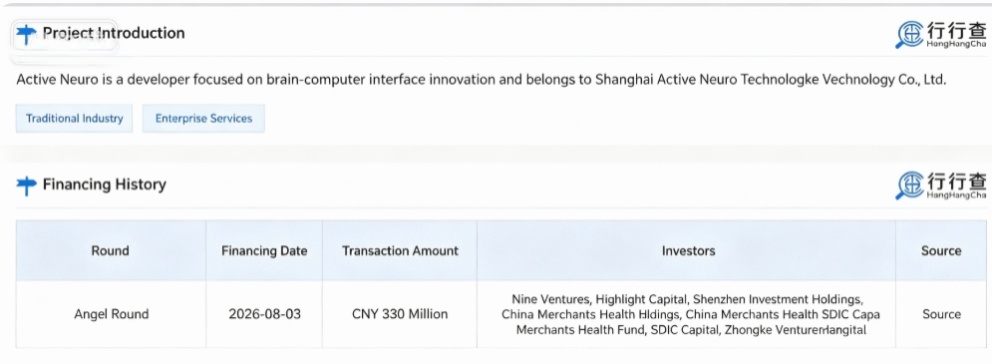
Founded in February 2026, Zhudong Technology was incubated by Lingang Laboratory. The company focuses on the R&D and industrialization of invasive brain-computer interfaces (invasive BCIs). Proceeds from this financing round will be primarily allocated to facility expansion, equipment upgrade, clinical trials and team development.
This financing round is labeled China’s largest angel round in the brain-computer interface (BCI) sector.
Based on incomplete statistics from public disclosures as of August 3, 2026, under strict statistical criteria of fixed clear deal value, single-tranche financing and standard angel round definition, Zhudong Technology ranks first among all domestic BCI enterprises with its RMB 330 million round, followed by Gestala, which previously closed a RMB 150 million angel round as the second-largest deal. Zhudong Technology has lifted the previous industry record to 2.2 times its original figure.
In May 2026, Shenfu Jianxing disclosed the completion of over RMB 300 million in a series of financing rounds. Some media categorized this package as angel-stage financing; however, public filings do not break down the exact amount raised at each standalone financing tranche, so it cannot be counted as a single independent angel round in the ranking. Gestala later secured RMB 420 million in an angel-plus round, which is also excluded from the scope of standard angel rounds.
In other words, the RMB 330 million record is not based on the broad definition of "early-stage financing", but comes from a single standalone round with a clearly disclosed funding amount. That said, the financing scale is merely one indicator to evaluate the company. A more noteworthy question arises: why does an invasive brain-computer interface startup—newly founded and yet to launch formal clinical validation of its products—need to raise such a large sum at such an early development stage?
The answer may lie in the shifting competitive landscape unfolding within the invasive brain-computer interface sector: the industry has gradually moved beyond competitions centered on isolated technologies and entered head-to-head rivalry focused on systematic engineering and clinical translation capabilities.
#What Does a Large-Scale Angel Round Need to Underpin?
Invasive brain-computer interface technology is extremely capital-intensive.
A clinically viable system usually integrates implantable electrodes, analog front ends, dedicated chips, wireless communication, power supply, packaging, neural signal decoding, surgical instruments and clinical software all at once. Failure to form a complete engineering closed loop in any single link will stall the overall product development.
The more substantial costs stem from clinical trials and manufacturing.
Implantable brain-computer interfaces are generally regulated as high-risk medical devices. To transition from R&D prototypes to clinically available products, enterprises must establish a full quality management system, complete type testing, animal validation, registrational clinical trials and long-term safety follow-up, as well as build production facilities that meet regulatory standards. Such heavy investment cannot be fully borne by a lean team of merely dozens of staff.
Zhudong Technology has built approximately 2,500 square meters of office space and GMP workshop premises to date. Per the company’s roadmap, its new headquarters will span over 10,000 square meters by the end of 2026, housing a micro-nano processing platform, while the team will expand to more than 100 employees.
This means proceeds from this financing round cover not only product R&D expenses, but also the development of technical platforms and organizational capabilities.
Compared with conventional medical devices, brain-computer interfaces feature a much broader scope of R&D. To independently master electrodes, chips, algorithms and complete equipment in-house, a firm must recruit multidisciplinary talents covering micro-nano fabrication, electronic engineering, neuroscience, artificial intelligence, medicine and quality management. Though RMB 330 million appears to be a sizable angel round, it merely serves as foundational capital to push the company into clinical development when viewed against the full development cycle of invasive BCIs.
What capital buys is R&D timeline and room for trial and error—not clinical outcomes.
#Beyond the 1,024-Channel Milestone
The product with the fastest development progress at Active Technology is the sports brain-computer interface system "Tianshu".
Designed for patients suffering from motor and speech dysfunctions caused by stroke, spinal cord injury, ALS and other conditions, the product captures and decodes patients’ neural activity to enable them to control external devices, thereby restoring communication and motor functions.
According to the company’s disclosure, its core team obtained the type test report for a 1,024-channel invasive brain-computer interface system in November 2025. The firm plans to launch clinical trials based on this system; with smooth progress, it will join the first echelon of domestic high-channel-count invasive BCIs undergoing clinical translation.
A 1,024-channel count stands as a key engineering metric.
When other parameters remain comparable, a higher number of effective channels allows the system to record more neural activity simultaneously, laying a foundation for fine motor decoding and high-bandwidth human-machine interaction. In terms of channel magnitude, the Tian Shu system has reached a channel count close to that of world-leading implantable brain-computer interface systems.
Nevertheless, channel count alone cannot serve as the sole evaluation criterion for brain-computer interfaces.
After electrode implantation, how many channels can capture valid neural signals; how many remain functional after months or years; whether signals will gradually degrade due to tissue response and electrode displacement; the reliability of wireless transmission, power supply and packaging; and whether the system can operate stably long-term outside laboratory environments — all these factors reflect the true value of the product far better than nominal paper specifications.
High channel counts also introduce new engineering burdens. A larger volume of signals demands enhanced data processing and transmission capabilities, while raising system power consumption, heat dissipation loads and algorithm computing pressure. If the proportion of valid signals remains low, simply adding extra channels will not deliver a proportional improvement in decoding performance.
Type testing verifies whether a product can operate stably in accordance with its established design, while clinical trials address a separate set of questions: whether the device is safe, whether it delivers repeatable functional improvements for patients, and whether such improvements can be sustained over time.
Therefore, while the 1,024-channel milestone merits close attention, it is by no means the finish line. The most critical metrics for Zhudong Technology in the next phase will not be total channel count, but effective channel ratio, long-term signal stability, decoding performance and tangible clinical benefits for patients.
#The three product lines each boast strengths while facing mounting pressures.
Active Technology has simultaneously deployed three categories of brain-computer interface products covering motion, vision and emotion, making it one of China’s domestic invasive BCI enterprises with the broadest product portfolio coverage to date.
From a platformization perspective, this layout is rational.
Though the three product lines target distinct brain regions and clinical demands, they share accumulated technologies including flexible electrodes, implantable chips, wireless communication, data acquisition and partial algorithm architectures. With a sufficiently mature underlying platform, the company can develop clinical products of various forms based on this foundation, instead of building a full independent system from scratch for each product line.
The technological reserves of Lingang Laboratory in materials, electrodes, chips, algorithms and system integration also lay a foundational foundation for this multi-product layout. Zhudong Technology’s core technical team is led by three doctors, Jia Jing, Zhao Bin and Yi Guoliang, while CEO Wu Guojia boasts extensive experience in the R&D, manufacturing and commercialization of Class III medical devices. The company has also established a scientific advisory committee covering neuroscience, flexible electrodes, algorithms, wireless power supply, optogenetics and other relevant disciplines.
This team composition of scientists, medical device executives and external advisors helps cut down communication barriers between cutting-edge research and clinical product development.
Nevertheless, a broader product portfolio brings higher requirements for clinical deployment and organizational capacity.
Motor function restoration, visual reconstruction and neuromodulation for emotional disorders cannot be simply regarded as variations of a single product deployed across different clinical departments. The three product categories differ in implantation sites, underlying neural mechanisms, target patient cohorts, surgical protocols and primary clinical endpoints, and regulators will also conduct distinct risk-benefit assessments for each.
Among them, motor brain-computer interfaces come with relatively well-defined patient demands and evaluation metrics, and represent the field with the largest concentration of human trials for implantable BCIs worldwide to date. Visual BCIs entail more complex challenges including visual information encoding and cortical stimulation. Meanwhile, emotional BCIs involve mechanisms of psychiatric disorders, long-term neuromodulation and ethical boundaries, leading to greater difficulty in clinical evaluation.
Therefore, while the three product lines can fully embody the value of the underlying technology platform, they also risk diluting limited early-stage resources. Zhudong Technology needs to establish clear clinical priorities at an early stage: complete robust human clinical validation for one product line first, before rolling out the core platform to other indications.
For Zhudong Technology at its current development stage, prioritizing the advancement of the Tian Shu system into clinical trials is likely more critical than pursuing full maturity across all three product lines simultaneously.
#Incubation via research platforms does not equate to completed industrialization.
Another noteworthy dimension of Zhudong Technology lies in its model of technology transfer backed by Lingang Laboratory.
In the past, most domestic BCI startups originated from university research groups. After incorporation, such companies gradually recruited talents covering engineering, manufacturing, clinical research and regulatory affairs. This model ensures consistent technological R&D trajectories, yet frequently leads to a prominent imbalance: strong academic research capabilities paired with insufficient product industrialization capacity.
The incubation model based on research platforms offers an alternative development pathway.
Laboratories can sustain long-term development of underlying technologies and shared infrastructure, while enterprises take over research outcomes suitable for industrialization and establish dedicated engineering and clinical teams through independent financing. Compared with startups built from scratch, such companies generally possess more comprehensive technical reserves and gain easier access to equipment, talent resources and research collaboration support.
Nevertheless, the commercialization of laboratory research achievements is far from a simple transfer of technology.
Academic research pursues technological novelty and extreme performance limits, while medical device development prioritizes stability, manufacturability and verifiability. An electrode with excellent lab performance must meet stringent requirements for batch consistency, sterilization, packaging, logistics and long-term implantation after industrialization. Similarly, an algorithm that yields outstanding results on limited datasets is required to sustain stable reliability across varied patient populations, extended usage cycles and diverse real-world operating environments.
A full spectrum of easily underestimated engineering work lies between laboratory research and clinical application.
Whether Zhudong Technology can formulate distinct intellectual property boundaries, stabilize manufacturing processes, build decision-making mechanisms adapted to medical device R&D, and shape product definitions genuinely driven by clinical demands will determine the industrial value that Lingang Laboratory’s technological reserves can deliver through commercial transformation.
This is not only a test for a single enterprise, but also an examination of the commercialization mechanism for high-level domestic scientific research platforms.
#After Record-Breaking Fundraising
As brain-computer interfaces enter a development phase jointly fueled by industrial policies and capital markets, the industry requires a new set of evaluation frameworks.
Financing scale, channel counts, lab demonstrations and parameter comparisons with international peers can help external stakeholders grasp project progress, yet none can substitute clinical outcomes.
The key metrics worthy of continuous tracking going forward are as follows: when the 1024-channel system will complete its first-in-human implantation; what patient cohorts and primary clinical endpoints will be selected for clinical trials; how long valid neural signals can remain stable post-implantation; whether the product can deliver repeatable standardized workflows for surgery, algorithm calibration and daily usage; and whether the micro-nano fabrication and GMP-compliant manufacturing platform can sustain consistent mass supply.
These milestones will determine whether the RMB 330 million financing constitutes forward-looking long-term investment, or merely a bundled valuation based on early-stage technical expectations.
From an industrial perspective, the emergence of large-scale angel rounds carries positive implications. It indicates that capital investment in China’s brain-computer interface industry is shifting from peripheral applications to core components, system platforms and regulatory clinical development. Major financing secured by enterprises including Zhudong Technology, Jieti Medical, Shenfujianxing and Zhiran Medical also demonstrates that the invasive BCI track has fostered a cohort of companies with considerable scale.
Nevertheless, developing invasive brain-computer interfaces is a years-long marathon. Record-high financing only puts the company at the starting line earlier, yet it cannot shorten the timeline required for medical clinical verification.
Zhudong Technology has secured a solid starting foundation in capital, research platforms and talent reserves. Going forward, the first batch of human trial data matters far more than the RMB 330 million financing; stable long-term functional channels outweigh a 1024-channel array; and delivering one fully functional product accessible to real patients takes precedence over advancing three product lines simultaneously.
Capital has rendered its judgment. Clinical data will deliver the final verdict.