On July 2, the National Medical Products Administration (NMPA) announced that it has approved the registration application for the innovative intracranial stent developed by Sino-Keno Medical Technology (Shanghai) Co., Ltd.
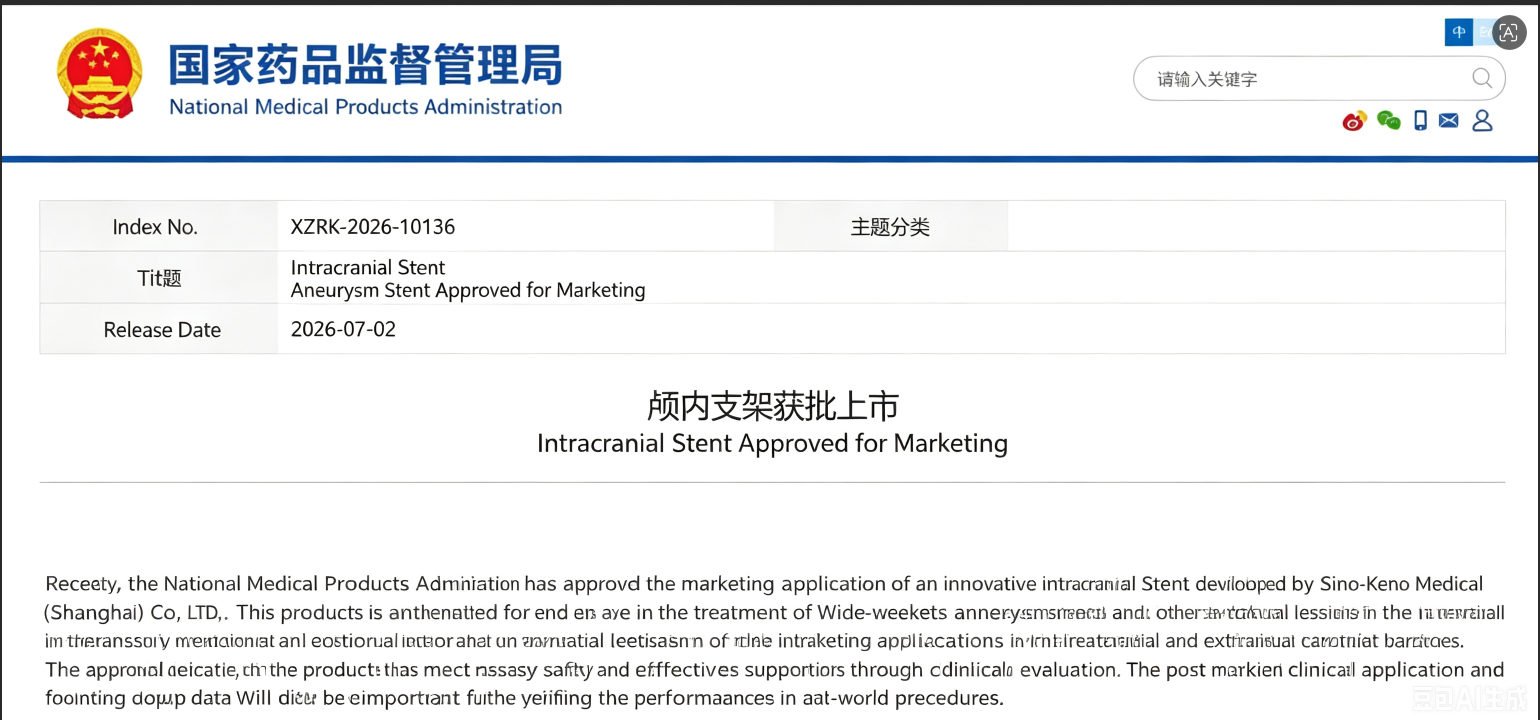
According to official documents, the product consists of a stent and a delivery system, and is used in conjunction with embolization devices for the treatment of saccular wide-neck aneurysms in the anterior intracranial circulation.
These design features basically address several practical challenges encountered during intracranial stent implantation: whether the device can smoothly navigate complex vascular pathways, whether it can achieve favorable apposition against the vessel wall after deployment, whether its position can be clearly visualized intraoperatively, and whether repositioning is available if the placement is unsatisfactory.

Wide-Neck Aneurysms: Why Are Auxiliary Stents Required?
Multiple interventional therapies are available for intracranial aneurysms. Taking the commonly used coil embolization as an example, physicians deliver coils into the aneurysm sac to achieve gradual occlusion of the lesion.However, wide-neck aneurysms feature broad necks, making it harder for coils to stay stably within the aneurysm sac. There also exists a risk of coil herniation into the parent artery.
The Society of NeuroInterventional Surgery (SNIS) of the United States offers a straightforward explanation for stent-assisted coiling: a stent is deployed in the blood vessel adjacent to the aneurysm to provide support for coils and retain them within the aneurysm sac.
The registration description of Sino-Keno’s new product states that it is “for use with embolization devices”. The brief public notice released by NMPA does not further specify the exact type of embolization device.Accordingly, stent-assisted coiling merely serves as background knowledge to help understand the clinical rationale of such products, and shall not be regarded as a direct replacement for the registered scope of application of this product.
In terms of device design, Sino-Keno has adopted a solution featuring spliced helical wires with closed mesh, closed-loop structure and full radiopacity. The intended performance indicators specified by NMPA include flexibility, vessel wall apposition, repositionability and retrievability, as well as precise deployment. For intracranial stents, all these properties are directly linked to delivery and release procedures. As for the performance of different designs in specific clinical cases, further observation based on subsequent clinical practice and post-market surveillance data is still required.

From clinical trial enrollment in 2023 to official approval in 2026
The R&D timeline of this product can be traced back approximately three years.
In July 2023, Sino-Keno Medical announced that the first subject enrollment for the clinical trial of this intracranial stent had been completed at Henan Provincial People’s Hospital. The company disclosed at that time that the trial adopted a prospective, multicenter design, the product was a self-expanding vascular stent, and highlighted its helical structure and full radiopacity performance.
In August 2024, the Center for Medical Device Evaluation (CMDE) of NMPA published the review results of the 7th special approval application for innovative medical devices of 2024, which included the intracranial stent submitted by Sino-Keno Medical. The public notice period ran from August 2 to August 16. The company subsequently officially named the product "SkyPort Intracranial Stent (Tianxing)" on its official website. In July 2026, NMPA formally announced the approval of Sino-Keno Medical’s innovative intracranial stent.
Therefore, based on available public information, there is substantial publicly disclosed corporate evidence supporting the correspondence between this newly approved product and the SkyPort R&D pipeline.
Founded in August 2014, Sino-Keno Medical mainly focuses on interventional devices for stroke and peripheral vascular diseases. According to information on its official website, its product portfolio covers intracranial thrombectomy stents, thrombus aspiration catheters, microcatheters, balloon guiding catheters and other products.On November 5, 2025, the company’s SkyVega flow-diverting stent obtained NMPA approval, with the registration certificate number National Medical Device Registration No. 20253132276. Following the recent approval of this intracranial stent, the company now offers two distinct types of aneurysm-related devices: auxiliary stents and flow-diverting stents.

Domestic Auxiliary Stents: Diversified Technical Routes Are Emerging
This niche market is not an untapped space.
Among imported products, the Neuroform Atlas Intracranial Stent System manufactured by Stryker has obtained domestic registration approval, with the NMPA public record registration number Imported Medical Device Registration No. 20203130290.
The intracranial stent system from MicroVention has also been registered in China, with the corresponding public record number Imported Medical Device Registration No. 20213130513.
The number of domestic innovative products has also been growing over the past two years.
In 2024, the intracranial aneurysm embolization auxiliary stent developed by Shanghai MicroVention Medical was approved as an innovative medical device. According to NMPA’s public information, the stent is laser-cut from nitinol tubing, with platinum-iridium radiopaque markers arranged at both ends and in the middle of some models.
In 2025, the intracranial aneurysm embolization-assisting stent developed by Jiangsu Changyida Medical was granted approval. The device adopts a self-expanding elastic structure braided from single filaments with closed ends. The flare angle at both ends and stent length are adjustable. Its structural design is intended to reduce vascular injury and improve vessel wall apposition, with the option to locally boost metal coverage rate as needed.
By contrast, Sino-Keno Medical’s newly approved stent adopts a design with spliced closed-mesh helical wires, closed-loop structure and full radiopacity. When comparing these products side by side, it is clear that domestic auxiliary stents have adopted distinct engineering approaches: some are laser-cut from nitinol tubes, some are braided from single filaments, while others feature spliced helical structures. They also differ significantly in radiopaque design, end structure, as well as repositioning and retrievability performance.
These structural differences cannot directly determine clinical advantages or disadvantages, but they at least demonstrate that competition has moved beyond simply "whether domestic products exist" to a more refined stage focusing on detailed device design.

Multiple Technical Routes Exist for Aneurysm Interventional Therapy
Beyond auxiliary stents, interventional devices for intracranial aneurysms are also evolving along other technical directions.
Flow-diverting devices feature stent structures with high metal coverage to redirect blood flow away from the aneurysm sac. Intra-aneurysmal embolization devices, by contrast, deploy implants inside the aneurysm cavity. These devices operate via different mechanisms and are not fully interchangeable in clinical indications. The SNIS has drawn a clear distinction between flow-diverting devices and stent-assisted embolization.
Since the start of 2026, domestic regulatory approvals have reflected this parallel development of multiple technical approaches. In January, NMPA granted approval for Shanghai Mimi Medical’s Self-Expanding Intra-Aneurysmal Embolization Device. On June 29, Beijing Taijie Weiye’s Aneurysm Intra-Sac Embolization System obtained market clearance. On July 2, Sino-Keno Medical’s innovative intracranial stent was approved.
These products do not fully compete head-to-head, yet together they reflect a notable shift: the arsenal of domestic interventional devices for intracranial aneurysms has become far more diverse. Manufacturers now face competition not merely between individual products, but across treatment solutions tailored to varying aneurysm morphologies, vascular anatomies and procedural requirements.
For Sino-Keno Medical, this newly approved product complements its intracranial aneurysm product portfolio. What merits greater attention going forward will be its apposition performance, operator feedback, long-term follow-up results and post-market data after clinical deployment. For a permanently implanted intracranial stent, such real-world information carries more weight in determining its long-term competitiveness than structural parameters alone.